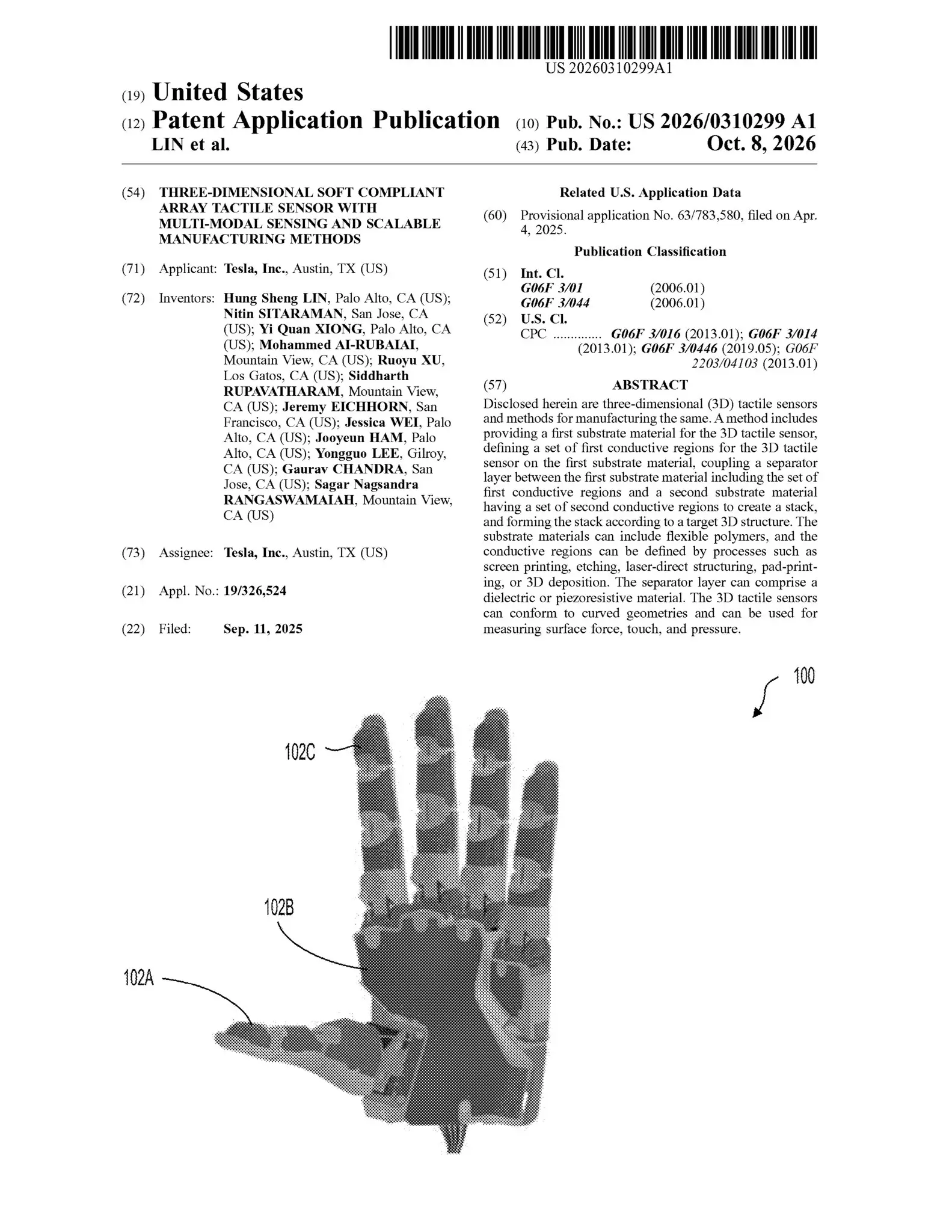
Published on 8 October 2026, Tesla’s patent application US 2026/0310299 A1, “Three-Dimensional Soft Compliant Array Tactile Sensor with Multi-Modal Sensing and Scalable Manufacturing Methods,” describes a soft tactile array designed to conform to robotic fingers, thumbs and palms using flexible substrates, conductive patterns, and capacitive or piezoresistive sensing.
But tactile intelligence is not simply a sensor-manufacturing problem. Without addressing fundamental engineering challenges, I expect this approach to struggle with the reliability and precision required for dexterous humanoid manipulation.
1. 3D forming can compromise sensing accuracy. Thermoforming can alter electrode spacing, dielectric thickness, and conductor geometry, affecting sensitivity and calibration. Without quantified post-forming performance and manufacturing tolerances, scalability remains unproven.
2. A pressure map is not a force map. Detecting contact is different from measuring multidirectional shear, torsion, and incipient slip. Earlier research, including Flexible Tactile Sensor Array (2017) and Soft Three-Axis Capacitive Force Sensor (2023), has demonstrated curved-surface tactile arrays and three-axis capacitive sensing for robotic hands. What does Tesla’s architecture contribute beyond these established approaches?
3. Mechanical fatigue is inevitable. Repeated bending, gripping, and impacts can cause trace fatigue, polymer creep, hysteresis, and delamination. Without validated fatigue life and calibration stability, performance may deteriorate precisely when the robot needs reliable touch.
4. More sensing elements do not guarantee better manipulation. Dense arrays can generate enormous amounts of data without reliably estimating friction, grip stability, or impending slip. Translating measurements into physical intelligence requires low-latency perception and closed-loop control.
5. Manufacturing methods do not prove scalability. Printing, etching, deposition, and molding do not establish production yield, repeatability, unit economics, or service life. These must be demonstrated.
Rather than treating compliant materials merely as substrates for sensors, my work with Mattrbot – Robotic Soft Material demonstrated robotic soft material as an integral part of the physical system. When compliance, deformation, sensing, and interaction are designed as separate layers, each interface introduces integration and calibration challenges. A more integrated, material-level approach could potentially reduce these burdens while enabling richer physical interaction.
Tesla’s approach may deliver basic tactile sensing. However, without demonstrated multidirectional force reconstruction, long-term stability, fatigue resistance, and measurable improvements in manipulation, I expect significant limitations in demanding real-world applications.