The Humanoid Transition and Re-architecting Civilization
Humanoids 0:1 does not describe a product version or a new generation of humanoids. It describes a transition.
The term is an analytical threshold, the point at which humanoid robotics become sufficiently capable, reliable, economically viable, scalable, and sustainable to perform physical work as infrastructure rather than demonstration.
The distinction between 0 and 1 is not binary, nor does it imply the disappearance of biological agency. ‘0’ represents a civilization in which physical work remains fundamentally biological, ‘1’ represents one in which it becomes increasingly artificial, programmable, reproducible, and scalable, performed by machines and distributed across physical systems. Humanoid robotics forms the critical bridge between these conditions.
Artificial intelligence has begun to change the economics of cognition. The next question is whether intelligence can be coupled to physical systems with sufficient reliability, autonomy, and economic viability to make physical agency increasingly reproducible. This work argues that humanoid robotics should therefore be understood not primarily as a new category of machines, but as a possible transition in the architecture of civilization. AI increasingly separates intelligence from the biological body, while embodied systems attempt to reconnect that intelligence with the physical world. If that connection becomes scalable, the consequences extend far beyond the adoption of robots. They could alter the economics of labor, production, scarcity, and ultimately the organization of civilization itself.
The question is not whether such a world is guaranteed. The question is whether the technological trajectory now emerging is capable of producing it. This work argues that it is. But it also argues something more important. The most difficult part of the transition may not be building the humanoid. It may be building the economic, energy, material, social, and institutional conditions capable of supporting artificial physical intelligence at scale. The period ahead therefore deserves to be understood not simply as the beginning of a humanoid robotics era, but as a possible transition in the architecture of civilization.
The Central Proposition.
Humanoids 0:1 develops this argument through four lenses of Hindsight, Insight, Foresight, and Oversight. Hindsight examines how automation has historically advanced through specialization rather than imitation of the human form. Insight examines the convergence of foundation models, simulation, physical data, increasingly capable actuators, and fleet learning. Foresight develops a framework for artificial labor, productive-hour economics, and the emergence of the next Humanoid. Oversight tests the proposition against the constraints that may determine whether the transition can actually scale with energy, materials, safety, employment, concentration of economic power, and ecological limits.
The central proposition is deliberately stronger than the claim that humanoids will become widespread. It is also deliberately conditional. If physical intelligence reaches a threshold at which high-level intent can be translated into reliable action across unfamiliar environments, while each deployed machine contributes data and economic value that improve subsequent deployment, then physical agency begins to exhibit a form of scalability previously associated primarily with software. At that point, the individual robot is no longer the correct unit of analysis. The relevant economic object becomes the fleet, the infrastructure, and the learning system that connects them.
This distinction is fundamental. The question is not simply whether a humanoid can perform a task. Increasingly, demonstrations suggest that many tasks are technically possible. The deeper question is whether physical intelligence can perform enough economically useful work, reliably enough, for long enough, at a sufficiently low total system cost, while the energy and materials required for deployment remain acceptable. The critical threshold is therefore not robot count. It is self-reinforcing deployment, the point at which deploying another physical intelligence system becomes economically rational because the systems already deployed have made the next system cheaper, more capable, more reliable, or more productive.
This possibility can be understood within the longer history of civilization as a history of externalizing capabilities once locked inside the human body. Fire externalized control over heat. Agriculture externalized the production of food. Machines externalized muscle. Electricity made energy transportable and controllable. Computing externalized calculation and memory. Networks externalized communication. Artificial intelligence is now externalizing increasingly general forms of reasoning. Humanoids represent a different step which is the attempt to externalize physical agency itself.
The significance, therefore, is not that a machine has two arms and two legs. It is that a machine may begin to translate intention into physical action without requiring every action to be explicitly engineered. That distinction is easy to underestimate. Traditional industrial automation is extraordinarily capable precisely because it sacrifices generality for specialization. A machine can repeat a defined motion millions of times under controlled conditions. Humans remain economically valuable where environments are variable, tasks are poorly specified, or the cost of redesigning the environment exceeds the cost of employing a person. Humanoid robotics confronts precisely this boundary, the unstructured physical world.
The opportunity emerges from the convergence of three curves. First, machine intelligence is becoming more general. Second, robotics hardware is becoming more capable, cheaper, and increasingly manufacturable. Third, simulation and real-world deployment are generating new forms of physical data. Their intersection creates the possibility of a learning system in which each robot is not an isolated machine, but a sensor and actuator connected to a larger intelligence. Physical deployment can therefore become part of the learning process itself. The robot acts, encounters variation, generates data, improves the model, and potentially makes subsequent deployment more capable and economical.
Humanoids 0:1 consequently makes no prediction that humanoids must succeed. Specialized robots may remain superior in many environments. Battery and energy limitations may constrain deployment. Physical reliability may prove substantially harder than current demonstrations suggest. Labor markets may adapt faster than expected, while institutions may resist or regulate automation. Energy, material, and ecological constraints may become binding. These possibilities are not peripheral objections. They are tests of the proposition.
This work therefore does not attempt to predict a date for the next Humanoid. It proposes a framework for recognizing the transition. The question is not when the world reaches a certain number of humanoid robots. The question is when physical agency itself begins to scale.
Method, Evidence, and Assumptions.
This work separates evidence from inference. Primary evidence includes official statistics from institutions such as the International Federation of Robotics, International Energy Agency, United Nations and World Health Organization. Independent evidence includes peer-reviewed research. Forecasts are identified as forecasts. Company-reported technical claims are treated as claims rather than independent validation. Finally, original analytical constructs in this work are explicitly presented as inferences rather than established industry standards.
This distinction matters particularly in humanoid robotics. The field is developing faster than conventional statistical systems can measure it. Demonstrations are not deployment. Deployment is not utilization. Utilization is not economic productivity. Economic productivity is not civilization-scale sustainability. A serious work must therefore resist the temptation to convert a sequence of impressive demonstrations into a single deterministic forecast.
The numerical figures used in the publication figures are deliberately conservative and traceable. For example, the industrial robot baseline comes from IFR, the data-centre electricity outlook comes from the IEA, demographic aging comes from the UN, and labor-market projections come from the World Economic Forum. The humanoid-specific battery discussion draws on a 2026 peer-reviewed article. These sources establish the terrain on which the original argument is built.
01. Before the Humanoid.
The humanoid story begins long before the humanoid. It begins with a question about what humans have always tried to do with machines that is move capabilities outside the biological organism. Human beings are unusual not because they possess strength, speed or memory in absolute terms, but because they repeatedly build systems that preserve useful capabilities outside the body. A tool does not merely extend a hand. It changes the boundary of what the hand can do. A machine does not merely multiply muscle. It changes the economic value of muscle. A computer does not merely calculate faster. It changes the value of calculation itself. This historical perspective is important because it changes how the current robotics wave should be interpreted. The industrial robot did not fail to become humanoid. It succeeded by refusing to be one. A welding robot does not need to walk, climb stairs or manipulate a kitchen. It needs to weld with repeatable precision. The economic history of automation is therefore a history of specialization.
IFR reports that 542,000 industrial robots were installed worldwide in 2024, more than double the number installed a decade earlier. The global operational stock reached about 4.664 million units. Asia accounted for 74% of new deployments, while China alone represented 54% of global installations. These figures are a reminder that robotics is not a speculative future industry waiting to begin. Automation is already a large industrial system. The humanoid proposition is different. It asks whether the economics of specialization can be partially replaced by the economics of generality. If one machine can perform a broader range of tasks without redesigning the environment for every task, its value is not simply the task it performs. Its value is the optionality it creates.
That optionality is expensive. General-purpose systems have historically been less efficient than specialized systems when the environment is controlled. The humanoid therefore enters the world with a paradox, its greatest advantage is flexibility, while its greatest disadvantage is that flexibility is technically difficult and economically costly. The transition from industrial robotics to humanoids should therefore not be described as a linear progression from simple robots to advanced robots. It is a change in the optimization problem. The old system optimized machines for environments. The new system attempts to optimize machines for environments that cannot always be redesigned.
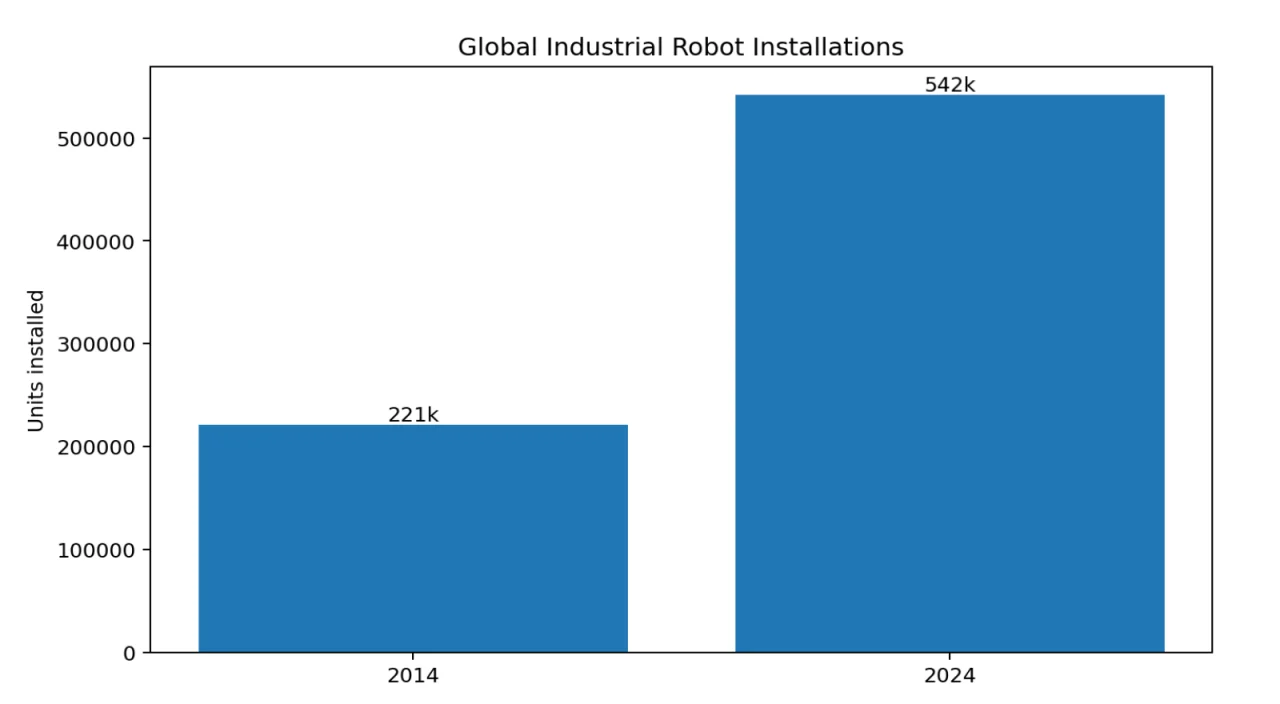
Figure 1. Global industrial robot installations, 2014 versus 2024. Source: International Federation of Robotics. The figure establishes the existing industrial robotics baseline, it is not a humanoid forecast.
02. Why Machines Look Like Us?
The strongest argument for humanoid morphology is not aesthetic. It is infrastructural. Civilization has already spent centuries designing physical environments around the human body. Doors, stairs, shelves, tools, vehicles, warehouses, kitchens, factories, control panels and countless other objects assume a particular body plan. A machine that can inhabit this environment without requiring the environment to be rebuilt inherits an enormous amount of existing infrastructure.
But the same fact can be turned around. If robots become sufficiently common, the economic logic may shift toward redesigning environments for machines. A warehouse can be built around wheeled robots. A factory can replace stairs with ramps. A building can expose machine-readable interfaces. A logistics system can eliminate many human handling steps.
This produces one of the recurring tensions that humanoid may be the best bridge into a human-built world without necessarily being the best endpoint of robotics. Humanoid 1.0 may therefore be the beginning of a heterogeneous physical intelligence ecosystem rather than the triumph of one universal body. The deeper significance of the humanoid is consequently not its shape. It is the attempt to create a general physical interface between intelligence and the world.
03. The First Separation of Intelligence and Body.
For most of human history, intelligence and physical agency were inseparable. A person could reason about an object, but the action still had to pass through a biological body. Tools extended the body, yet the source of agency remained human. Digital technology introduced a different architecture. Information could be stored, transmitted and transformed without the original biological body. The internet went further by allowing information to move globally with almost no relationship to the location of the person who produced it. Artificial intelligence pushes the separation further by allowing elements of reasoning to be executed by systems that are not the biological originators of the thought.
Humanoids represent an attempt to complete the loop. Intelligence can exist outside the body, but physical reality cannot. A model can describe how to pick up a cup, something must still move through space, apply force, absorb error and interact with matter. This is why embodied intelligence is fundamentally different from digital intelligence. In software, many errors are cheap to reverse. In physical systems, errors can damage objects, injure people, destroy equipment or simply consume time and energy. The physical world imposes friction on intelligence. The transition is therefore not AI plus a robot. It is the creation of a new interface between abstract intelligence and irreversible physical consequences.
04. Humanoids 0.
Humanoids 0 is the present state, machines that increasingly contain artificial intelligence but remain dependent on substantial engineering, supervision, constrained environments and carefully selected tasks. The distinction matters because a demonstration can conceal the amount of structure behind the demonstration. A robot may perform an apparently general task because the environment has been prepared, the objects are standardized, the route is known, the failure modes are bounded and a human remains nearby. None of these facts make the demonstration meaningless. They simply define its evidentiary weight.
The current phase should therefore be understood as an accumulation of ingredients rather than the arrival of the final system. Better models matter. Better actuators matter. Better batteries matter. Better simulation matters. Better data matters. Better manufacturing matters. But the system only crosses a civilizational threshold when these components reinforce one another. The purpose of calling the present state ‘0’ is not to imply failure. Zero is the starting coordinate. It describes a civilization in which physical agency is still overwhelmingly biological even as pieces of intelligence become artificial. The central question of the next phase is whether the coordinate system itself changes.
05. From Automation to Agency.
Traditional automation begins with a specification. Engineers describe the task, the sequence, the geometry and the acceptable tolerance. The machine then repeats the specification. Artificial intelligence changes the premise by allowing the machine to infer parts of the specification from examples, goals or interaction. The shift from automation to agency is therefore not simply an improvement in perception. It is a change in how the task itself is represented. A conventional robot may be told to move a component from A to B. A more general system may be told to prepare a workstation, identify what is missing, manipulate several objects and recover from small deviations.
This is where foundation models become important. Their significance for robotics is not that language suddenly becomes useful for robots. Their deeper significance is that a model trained to represent broad patterns may provide a reusable prior over the physical world. Instead of constructing every behavior independently, engineers can begin with a general model and specialize it through data. That does not solve embodiment. It changes the starting point.
06. The Physical Intelligence Stack.
A humanoid should not be treated as a single product. It is the visible edge of a stack that is compute, data, model, body, energy, manufacturing, fleet infrastructure and the physical environment. The first layer is compute. The second is data. The third is the model that turns data into behavior. The fourth is the body that includes actuators, sensors, structure, hands and control systems. The fifth is energy. The sixth is manufacturing. The seventh is fleet infrastructure. The eighth is the environment in which the system operates. This stack matters because progress in one layer can expose a bottleneck in another. Better models can make hardware the constraint. Better hardware can make data the constraint. More robots can make charging infrastructure the constraint. More deployment can make maintenance the constraint. The robot is therefore not the whole system. It is the point at which multiple industrial systems meet.
07. The Last Millimeter Problem.
The hardest physical problems are often not spectacular. They are small. A grasp misses by a few millimeters. A box is slightly heavier than expected. A surface has different friction. A cable is positioned differently. Packaging has deformed. A human moves unexpectedly into the workspace. These small errors are the physical equivalent of hallucination. A digital system can produce an incorrect sentence and try again. A physical system may drop the object, damage the product, stall the line or create a safety event.
Physical intelligence therefore requires a different definition of intelligence. A system that understands a task but cannot execute it reliably is not intelligent in the economically relevant sense. Useful physical intelligence is intelligence multiplied by reliability. This is why the path from demonstration to deployment is longer than the path from benchmark to benchmark. Industrial customers buy outcomes, not impressive videos.
08. The Fleet Brain.
The most consequential idea in physical AI may be fleet learning. A conventional machine is an individual asset. A networked learning robot can be both asset and sensor. One machine encounters a failure. Another machine encounters a different failure. If those experiences can be converted into useful training signals and propagated across the fleet, the deployment system begins to behave like a distributed organism. The implication is deep. Software improves because copies can be updated. A robot fleet could begin to inherit a similar property, although with far more friction because physical bodies differ, environments differ and hardware wears. The fleet, rather than the individual robot, may therefore become the unit of learning. This is one of the clearest conceptual differences between ordinary automation and physical intelligence.
09. The Factory Becomes Part of the Model.
Once robots learn from operation, the factory itself becomes a source of training data. Layout, lighting, object presentation, tooling, packaging and process design all affect what the robot sees and how it acts. The factory therefore stops being merely the place where the robot is installed. It becomes part of the intelligence system. This creates a feedback loop with better robots allow more deployment, deployment creates more data, data improves the model, better models increase reliability, higher reliability improves economics, and better economics support more deployment. The loop is not guaranteed to close. Data can be poor. Learning can saturate. Hardware can remain too expensive. But if the loop closes strongly enough, robotics begins to acquire an economic property normally associated with software by cumulative learning across copies.
10. Artificial Labor Capacity.
If intelligence can be coupled to a physical body that operates with limited supervision, the economic object changes. The machine is no longer simply capital equipment performing one task. It begins to resemble a unit of artificial labor. Artificial labor does not mean a one-for-one replacement of a worker. Labor is a bundle of perception, judgment, movement, communication, adaptation, social interaction and responsibility. A robot may reproduce some components while leaving others untouched.
The useful analytical quantity is therefore not the number of robots. It is productive physical capacity. A simple conceptual measure is Artificial Labor Capacity that is intelligence multiplied by embodiment, reliability and utilization. The equation is not intended as a production function. It is a reminder that a brilliant robot with poor uptime produces less than a less capable robot that works reliably. The economic transition begins when the marginal productive hour of a robot becomes competitive with the marginal cost of obtaining the equivalent physical effort by a human.
11. The Productive-Hour Economy.
Robot manufacturers often talk about unit price. Customers ultimately care about productive output. A robot that costs less but requires constant intervention may be more expensive than a robot with a higher purchase price and much better uptime. This work proposes Cost per Successful Productive Hour, or CSPH, as a more useful long-run metric, that is
CSPH = (CAPEX + energy + maintenance + compute + supervision + downtime) / successful productive hours
The phrase ‘successful productive hours’ matters. A robot that is powered for eight hours is not necessarily productive for eight hours. Charging, calibration, recovery, supervision and failure all consume time. This metric also reveals why utilization is central. A machine used 20% of the time is economically different from the same machine used 80% of the time. Physical AI therefore requires not just intelligence but operational integration.
12. The Transition Decade: 2027–2036.
The period from 2027 to 2036 should not be treated as a prophecy. It is better understood as a testing window in which the ingredients of the transition could either reinforce one another or fail to do so.
The first phase is validation. Factories test whether robots can perform useful tasks outside carefully scripted demonstrations. The important variables are failure rates, supervision time, uptime and economics.
The second phase is operationalization. Robots move from isolated pilots toward multi-task workflows. Fleet learning becomes more valuable because deployments generate heterogeneous data. The question becomes whether the system can reduce the amount of human intervention per productive hour.
The third phase is scaling. Manufacturing becomes an engineering problem in its own right. Supply chains, component standardization, charging, maintenance and software infrastructure begin to matter as much as individual robot capability.
The fourth phase is convergence. If the economic loop closes, artificial labor becomes a scalable production input. At that point, energy, materials, infrastructure and governance become the binding constraints.
The most important transition indicator is not a particular shipment number. It is self-reinforcing deployment, whether each generation of deployment makes the next generation easier, cheaper, more capable or more productive.
13. Humanoid 1.0.
Humanoid 1.0 is defined here as a threshold, not a product launch. It is reached when a physical intelligence system can translate high-level human intent into reliable, generalizable and economically productive physical action across sufficiently unfamiliar environments, while learning from fleet experience without proportional increases in human programming or supervision.
This definition deliberately contains five gates as intent, generalization, reliability, economics and sustainability. Intent asks whether the human can specify what should happen without specifying every movement. Generalization asks whether the system can handle conditions not represented exactly in training. Reliability asks whether the result is repeatable. Economics asks whether useful output exceeds total system cost. Sustainability asks whether the system can scale without unacceptable energy, materials or ecological consequences. A system that passes four gates and fails the fifth has not reached Humanoid 1.0.
14. The Humanoid 1.0 Readiness Framework.
To make the concept testable, this work proposes a weighted readiness index. Generalization and physical reliability receive the highest weights because without them a humanoid remains a narrow automation system. Economics receives 15%. Energy, fleet learning and manufacturing each receive 10%. Maintenance, circularity and safety/security each receive 5%. The weights are intentionally debatable. Their purpose is not to create a universal score but to force a more complete conversation. The industry can change the weights. What it should not do is measure maturity through one dimension such as task count or unit shipments.
The framework also contains a veto principle that is a catastrophic weakness in one critical dimension cannot be averaged away. A robot may be highly capable but unsafe. It may be reliable but uneconomic. It may be cheap but unsustainable. The transition is systemic.
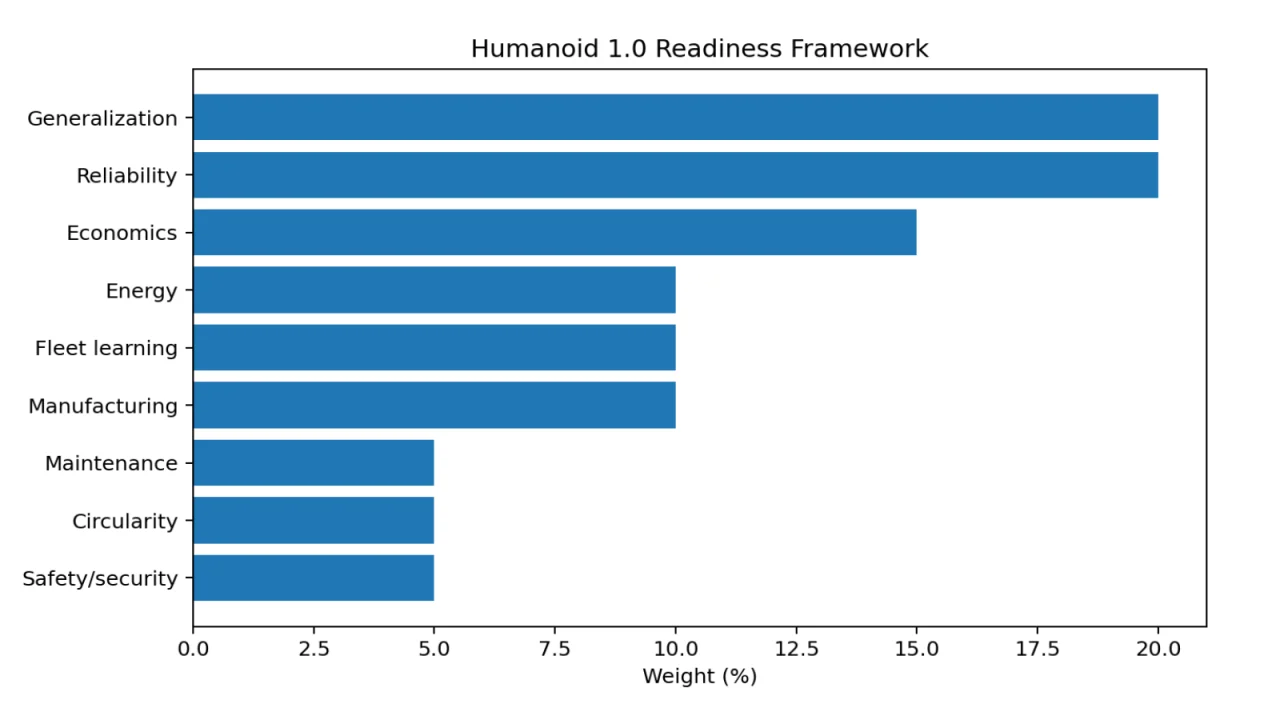
Figure 2. The Humanoid 1.0 readiness dimensions are one proposed analytical framework, not an industry standard.
15. The Energy of Intelligence.
Digital intelligence has already made electricity a strategic input to cognition. The IEA estimates that global electricity consumption by data centers was about 460 TWh (Terawatt-Hour) in 2024 and projects more than 1,000 TWh by 2030 and around 1,300 TWh by 2035 in its base case.
Physical intelligence adds another layer. A robot consumes energy not only to compute but to move. It carries its own energy storage, converts electricity into mechanical work and must manage the thermal and mechanical consequences of doing so.
The resulting system is recursive. More capable robots may perform more useful work, but greater capability can require more actuators, more sensing, more compute and more energy. The important metric is therefore not energy consumed per robot. It is useful physical output per unit of total energy and material input.
At fleet scale, charging stops being a product feature and becomes infrastructure. A million robots operating on different schedules imply a new electricity-load pattern. The physical intelligence economy will therefore be partly an energy system.
16. The Battery Bottleneck.
The battery is unusually important because it couples energy to mass. A fixed industrial robot can draw power from the grid. A mobile humanoid must carry its energy source. Every kilogram of battery changes the body, every change in body mass changes actuation requirements, changes in actuation change energy demand.
A 2026 Advanced Science review argues that uninterrupted commercial humanoid operation may require roughly a fourfold increase in battery-system volumetric and gravimetric capacity. The authors discuss application cases exceeding 10 kWh and identify requirements above 1,000 Wh/L and around 500 Wh/kg at the pack level for certain architectures.
These are not forecasts that the industry will certainly achieve. They are evidence that current energy storage may be one of the structural constraints on uninterrupted humanoid operation. The likely near-term answer may not be a miraculous battery. It may be a systems solution including swappable packs, charging infrastructure, task scheduling, hybrid duty cycles and redesigned workflows.
17. The Material Civilization.
A humanoid fleet is a material system. It contains structural metals, magnets, semiconductors, batteries, power electronics, sensors and many other components. Scaling physical intelligence therefore creates a new connection between software ambition and mineral supply chains.
The IEA’s 2026 Global Critical Minerals Outlook projects strong growth in demand for critical minerals through 2040. Lithium demand rises more than threefold in the stated policy scenario, while nickel, graphite and rare-earth demand grows by roughly 50% to 90%. Supply is also concentrated. China is the dominant refiner for several strategically important materials.
This does not mean humanoids will cause those mineral pressures. Electric vehicles, grid infrastructure, storage and renewables are already major drivers. The point is that robotics joins an existing competition for industrial materials.
Recycling becomes strategically important. The IEA estimates that secondary supply could roughly double its contribution by 2040, from around 10% today to close to 20% across key energy minerals. Physical intelligence therefore needs a circularity architecture from the beginning rather than treating end-of-life as an afterthought.
18. The Migration of Scarcity.
Civilization repeatedly changes its bottleneck. Agriculture reduced the scarcity of wild food but created new problems of land, coordination and disease. Industry multiplied mechanical energy but increased dependence on fuel, infrastructure and capital. Computing reduced the cost of calculation but created demand for electricity and semiconductor capacity. The same pattern may continue. If artificial labor becomes scalable, labor scarcity may decline in some domains while energy, materials, compute, infrastructure and social legitimacy become more important.
This is the central bottleneck migration hypothesis of this work that humanoids may not eliminate scarcity. They may relocate it. The consequence is subtle. A civilization with abundant artificial physical agency does not automatically become a civilization of abundance. It becomes a civilization in which the constraints on production are different.
19. Sustainability Is Not a Chapter at the End.
Sustainability is often placed at the end of technology narratives because it is treated as a constraint on an otherwise inevitable trajectory. That is the wrong architecture for physical intelligence. A system that cannot sustain its own energy, materials, maintenance and end-of-life requirements cannot scale. Sustainability is therefore not a moral appendix. It is part of technical feasibility. The relevant question is not whether one robot has an acceptable footprint. It is whether the marginal footprint of additional productive capacity remains compatible with the system that supports it.
The 2026 Environmental Science & Technology viewpoint on humanoid robot end-of-life waste makes this problem explicit. Humanoids combine batteries, complex electromechanical systems and high-grade electronics, while take-back, reverse logistics and end-of-life governance remain underdeveloped. A million machines create a waste-management problem even if every machine is individually efficient. The same is true of batteries, actuators and electronics. The architecture of deployment must therefore include maintenance, refurbishment, remanufacturing and recycling.
20. Labor Transition.
The labor question should not be reduced to ‘will robots take jobs?’ The more important question is how the composition of economic value changes when some physical tasks become cheap, reliable and continuously available.
The World Economic Forum’s Future of Jobs Report 2025 estimates that structural labor-market transformation could create 170 million jobs and displace 92 million by 2030, producing net growth of 78 million across its survey-based scenario. It also finds that frontline and care-related roles are among areas expected to grow.
These projections are not humanoid forecasts. They are useful because they show that labor markets do not behave as a single pool. Technology destroys, creates and transforms different tasks at different rates. Humanoid deployment is likely to be similarly uneven. Tasks that are physically repetitive, hazardous, difficult to staff or highly time-sensitive may be early targets. Tasks requiring trust, accountability, nuanced social interaction or irregular judgment may remain more resistant.
The key policy challenge is therefore transition speed. If artificial labor expands faster than institutions can create new pathways for human participation, the social problem may emerge before the technological one is fully understood.
21. End of Labor Scarcity?
The phrase ‘end of labor scarcity’ is intentionally provocative. Labor has never been scarce in the simple sense that people have never existed in sufficient numbers. What has been scarce is affordable, appropriately skilled, available labor at a particular place and time. Humanoids could change that relationship. A machine can potentially work in dangerous environments, operate at night, be relocated, be replicated and inherit software improvements. This creates a new form of elasticity.
But artificial labor will not automatically eliminate human labor. Capital must still be financed. Robots must be maintained. Energy must be purchased. Customers must exist. Regulation must permit deployment. The system must remain safe. The more plausible conclusion is that artificial labor could reduce the scarcity of certain forms of physical availability while increasing the relative value of other forms of human contribution.
22. The Concentration Problem.
A fleet-learning system creates an unusual economic possibility. Intelligence can improve through scale, while capital ownership can also concentrate through scale. If one organization controls the model, the data, the robot manufacturing system and the deployment network, the organization may possess a reinforcing advantage. More robots create more data. More data improves the model. Better models improve the robots. Better robots attract more customers.
This resembles platform economics, but with a physical layer. The result could be a concentration of productive capacity not simply in software platforms but in integrated physical intelligence systems. The counterweight is interoperability. If physical intelligence becomes an open infrastructure layer, multiple manufacturers could contribute bodies, models, sensors and services. The political economy of Humanoid 1.0 may therefore depend as much on standards as on engineering.
23. Physical AI Security.
Digital security protects information. Physical AI security protects the physical world. A compromised robot can do more than leak data. It can move objects, enter spaces, damage equipment, interfere with production or create direct safety risks. The attack surface therefore includes models, sensors, software, communication systems, update mechanisms, supply chains and physical access.
This creates a new requirement, physical systems need security architectures designed around consequences rather than only confidentiality. A model update should be treated partly like a software release and partly like a change to an industrial machine. The deeper issue is trust. A society that deploys millions of autonomous physical systems must know not only that they can act, but who is authorized to tell them what to do.
24. Post-Humanoid.
If Humanoid 1.0 succeeds, the humanoid may eventually become less important than the intelligence infrastructure behind it. Humans value general-purpose bodies because we are general-purpose organisms. Machines do not have to inherit that constraint. A fleet can contain humanoids where human compatibility matters, wheeled systems where efficiency matters, fixed manipulators where precision matters, drones where access matters and specialized machines where economics favors specialization.
The future physical world may therefore be heterogeneous. The common layer will be intelligence, orchestration, data and standards rather than morphology. This produces a counterintuitive conclusion that the success of humanoids may ultimately reduce the importance of the humanoid form.
25. Physical Intelligence Economy.
The economic unit of the physical intelligence era may not be the robot. It may be the service delivered by a robot network. A customer may buy a number of productive hours, a throughput guarantee, a maintenance contract or an outcome rather than a machine. This naturally favors Robotics-as-a-Service and other operating models in which the provider retains responsibility for uptime and performance.
The shift from ownership to productive capacity is economically important because it reduces the customer’s need to understand robotics as a technology. A factory does not want to become a robotics laboratory. It wants output. The winning companies may therefore be those that integrate hardware, software, fleet operations, maintenance, energy management and workflow redesign into a single productive system.
26. What Would Falsify the Transition.
A serious transition must state how it could be wrong. The first falsification would be persistent failure of generalization, if robots remain highly task-specific and every meaningful expansion requires bespoke engineering, the transition toward general physical agency would be weaker than proposed.
The second would be economic failure, if total system cost remains above the value of productive output even after manufacturing scale, the artificial-labor argument weakens.
The third would be energy and materials failure, if the physical resource requirements of scaled deployment become structurally incompatible with available infrastructure, the technology may remain useful but not transformative for the civilization.
The fourth would be organizational failure, if humans remain the bottleneck for supervision, maintenance and exception handling, the number of deployed robots could rise without creating proportional artificial labor capacity.
The fifth would be a better alternative. If specialized robotics combined with redesigned environments consistently dominates humanoids while providing the same economic flexibility, the humanoid may prove to be a transitional interface rather than the principal platform. These are not reasons to reject the transition. They are tests that should be applied to it.
27. Human Intelligence to Physical Intelligence.
The deepest transition is not from humans to robots. It is from intelligence being embodied in biological organisms to intelligence becoming increasingly independent of any single biological body. This transition began in fragments. Writing separated memory from the individual. Institutions separated decision-making from the person. Machines separated mechanical power from muscle. Computers separated calculation from the brain. Networks separated communication from physical proximity. AI now separates increasingly general forms of reasoning from the biological mind. Humanoids attempt to reconnect that artificial intelligence with the physical world.
The architecture can be written simply as
State 0: Intelligence ⇢ Body ⇢ Action.
Transition: Intelligence ⇢ Model ⇢ Artificial Body ⇢ Action.
State 1: Intelligence ⇢ Network ⇢ Fleet ⇢ Physical World.
State 1 is not a prediction that machines become conscious. It is a claim about the location of agency. Physical action no longer has to be coupled to one biological organism.
28. Bottleneck Migration.
The history of technology can be understood as a sequence of bottleneck migrations. Food constrained early societies. Mechanical energy constrained industrial production. Compute constrained digital systems. Intelligence increasingly constrains complex decision-making. If physical intelligence scales, energy, materials and infrastructure may become the next binding constraints.
This is why this work refuses to define abundance as simply ‘more robots’. A civilization can have millions of machines and still face scarcity if the machines require enormous amounts of electricity, specialized minerals, maintenance and centralized infrastructure. The correct question is always that what becomes scarce after the previous scarcity is relaxed?
29. Programmable Physical Civilization.
A programmable physical civilization is one in which physical production becomes increasingly programmable. A high-level objective can be translated into sequences of physical action by machines whose behavior improves through shared learning. This would alter the geography of production. Manufacturing could become less dependent on large concentrations of human labor. Warehouses could operate continuously. Infrastructure maintenance could become more autonomous. Dangerous environments could be serviced without exposing people. Care and assistance could be supplemented where demographic aging creates persistent shortages.
The demographic case is significant. The UN reports that the global population aged 65 or older was about 761 million in 2021 and is projected to exceed 1.6 billion by 2050. WHO now projects a global health-worker shortage of around 11 million by 2030. Neither trend implies that robots should replace caregivers or clinicians. It does imply that physical assistance and labor capacity will matter increasingly in aging societies. The promise of physical intelligence is therefore not merely substitution. It may be augmentation of civilization’s capacity to care, build and maintain.
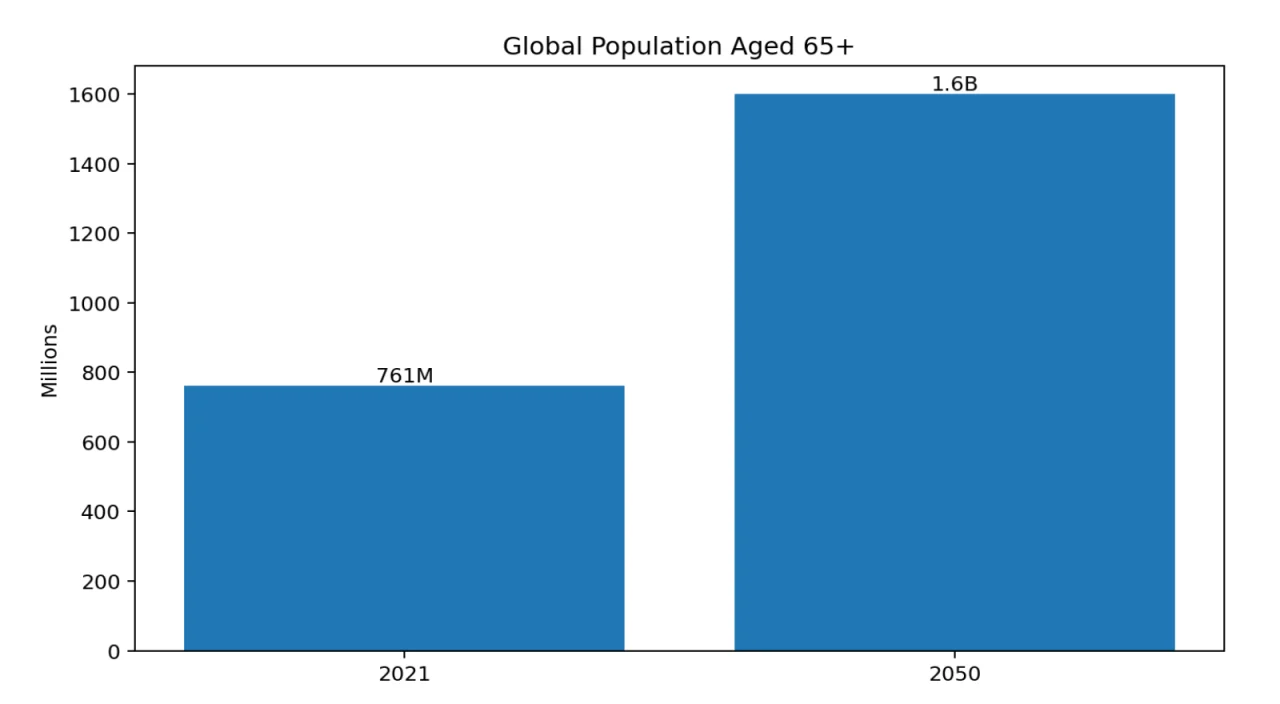
Figure 3. Global population aged 65+, using UN World Social Report figures of 761 million in 2021 and more than 1.6 billion projected in 2050. The demographic trend is a major reason care and physical assistance deserve attention in the humanoid debate.
30. The Most Important Question.
The most important question of the next decade is not whether we can build a humanoid. We almost certainly can. The harder question is whether we can build a physical intelligence system capable of scaling without making the civilization that created it unsustainable. That question contains the entire transition. It includes reliability because unreliable machines waste resources. It includes economics because uneconomic systems do not scale. It includes energy because every physical action consumes power. It includes materials because every machine is a material object. It includes governance because autonomous physical systems operate in shared spaces. It includes labor because societies must absorb changes in economic participation. Humanoid 1.0 is therefore not a robot benchmark. It is a civilizational benchmark.
31. Four Futures.
The future can be framed along two axes of scalability and sustainability. Green Scale occurs when physical intelligence scales while energy, materials, safety and circularity improve sufficiently to support it. This is the most constructive scenario when artificial labor expands without producing a proportional ecological burden.
Dirty Scale occurs when capability and deployment expand rapidly while the material and energy system struggles to keep pace. Productivity rises, but so do resource pressure and geopolitical dependence.
Sustainable Slow occurs when the technology works but remains constrained by cost, manufacturing or reliability. Society gains useful robots without experiencing a rapid labor transition.
Hype Trap occurs when capital and expectations expand faster than productive capability. In this world, robot counts and valuations may rise while utilization and economics remain weak. The purpose of the matrix is not to forecast which future wins. It is to show that technological success and civilizational success are different variables.
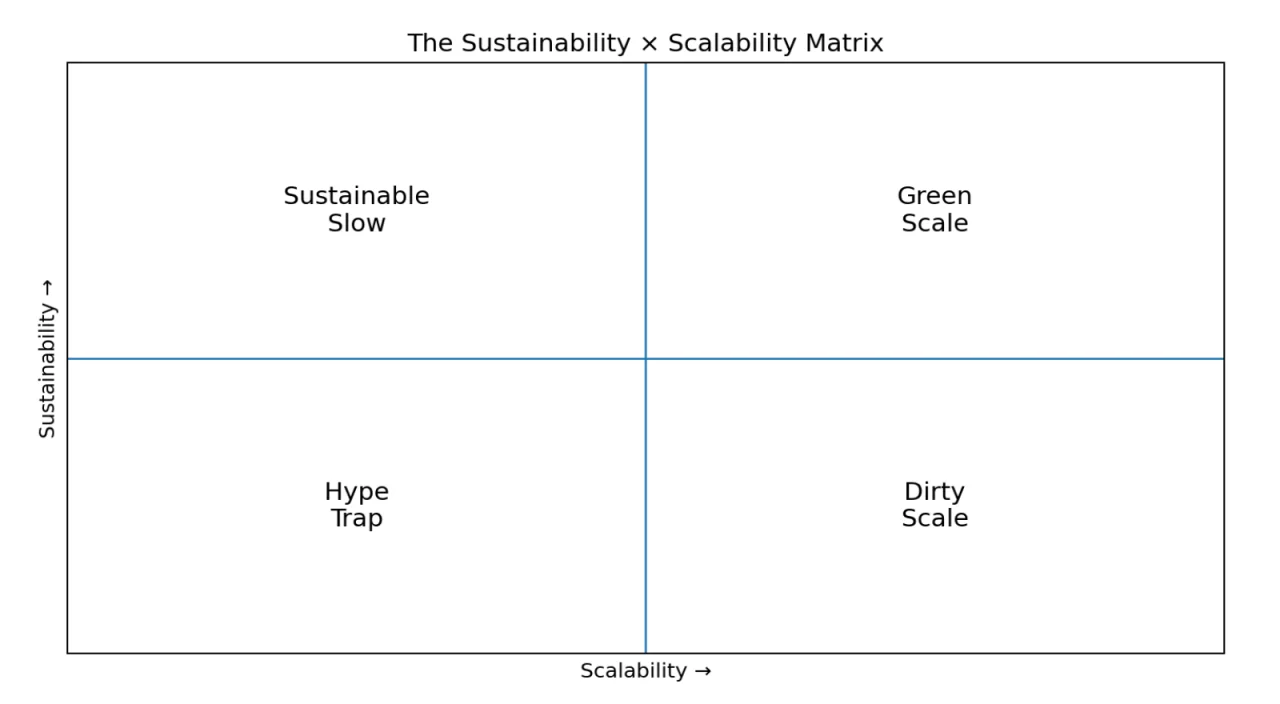
Figure 4. Sustainability × scalability is a proposed analytical matrix. The objective is to distinguish productive scaling from scaling that merely increases resource demand.
32. The Threshold.
The threshold from 0 to 1 is crossed when physical intelligence becomes self-reinforcing. The first meaningful threshold is therefore not one million robots. It is not a benchmark score. It is not a particular market valuation. It is the moment when deploying another robot becomes economically rational because the robots already deployed have made the next robot better, cheaper, more reliable, or more useful.
At that point, the system acquires a compounding property. Intelligence improves deployment, deployment creates data, data improves intelligence, scale improves manufacturing, manufacturing lowers cost, lower cost increases deployment. The loop is the transition. And the loop can fail. That is why the 0:1 notation is useful. Zero and one are not product generations. They are different architectures of possibility.
The Transition From 0 to 1.
There is a tendency to describe technological transitions through the objects they produce. The Industrial Revolution is remembered through machines. The digital revolution is remembered through computers. The internet is remembered through networks. Artificial intelligence is often remembered through models. But the deeper transitions are not objects. They are changes in what civilization can reproduce.
For most of history, physical agency was inseparable from biological life. To move a body, lift an object, inspect a machine, harvest a field, build a wall or care for another person, someone had to be physically present. Tools changed the scale of that agency, but humans remained the source of movement, judgment and adaptation. AI has begun to change the architecture of intelligence. Reasoning, perception and planning can increasingly exist outside the biological organism. Humanoids attempt to give that artificial intelligence a body capable of acting in the world.
If they succeed, the consequence will not simply be that factories contain more robots. The consequence will be that physical agency becomes increasingly reproducible. And when physical agency becomes reproducible, the economic meaning of labor begins to change. When labor changes, the location of scarcity changes. When scarcity changes, the architecture of civilization changes.
That is why the humanoid question is larger than the humanoid industry. The transition from 0 to 1 will not be decided by whether a machine can walk like a person. It will be decided by whether intelligence can become physically scalable without becoming economically, materially or ecologically self-defeating. The most important unit of the coming era may therefore not be the robot. It may be the productive hour, not the machine, but the fleet, not the body, but the intelligence system, not the demonstration, but the feedback loop, and not the number of machines, but whether each generation makes the next generation more capable.
Humanity has repeatedly removed one constraint only to discover another. Agriculture answered hunger and created coordination. Industry answered muscle and created energy dependence. Computing answered calculation and created electricity and semiconductor dependence. AI may answer elements of reasoning and reveal the scarcity of physical agency. Humanoids are an attempt to answer that scarcity. The question that follows is the one that matters most, can civilization make physical agency abundant without making the civilization itself unsustainable? That is the transition from 0 to 1.
Selected Bibliography and References.
[1] International Federation of Robotics. World Robotics 2025. Global industrial robot statistics for 2024. IFR, 2025. https://ifr.org/worldrobotics/report-2025
[2] International Federation of Robotics. ‘Global Robot Demand in Factories Doubles Over 10 Years.’ 25 September 2025. https://ifr.org/ifr-press-releases/news/global-robot-demand-in-factories-doubles-over-10-years
[3] International Energy Agency. Energy and AI. Paris: IEA, 2025. https://www.iea.org/reports/energy-and-ai
[4] International Energy Agency. Global Critical Minerals Outlook 2026. Paris: IEA, 2026. https://www.iea.org/reports/global-critical-minerals-outlook-2026
[5] World Health Organization. ‘Health workforce.’ Updated 2025/2026. https://www.who.int/health-topics/health-workforce
[6] United Nations Department of Economic and Social Affairs. World Social Report 2023: Leaving No One Behind in an Ageing World. United Nations, 2023.
[7] United Nations Department of Economic and Social Affairs, Population Division. World Population Prospects 2024. United Nations, 2024. https://www.un.org/development/desa/pd/world-population-prospects-2024
[8] World Economic Forum. The Future of Jobs Report 2025. Geneva: World Economic Forum, 2025. https://www.weforum.org/publications/the-future-of-jobs-report-2025/
[9] Bergschneider, et al. ‘Leading the Pack: Next-Generation Batteries for Humanoid Robotics.’ Advanced Science, 2026. https://doi.org/10.1002/advs.76736
[10] Castells, M. The Information Age: Economy, Society and Culture. Blackwell, 1996.
[11] Hayles, N. Katherine. How We Became Posthuman: Virtual Bodies in Cybernetics, Literature, and Informatics. University of Chicago Press, 1999.
[12] Ferrando, Francesca. ‘Posthumanism, Transhumanism, Antihumanism, Metahumanism, and New Materialisms.’ Existenz 8(2), 2013.
[13] Braidotti, Rosi. The Posthuman. Polity, 2013.