
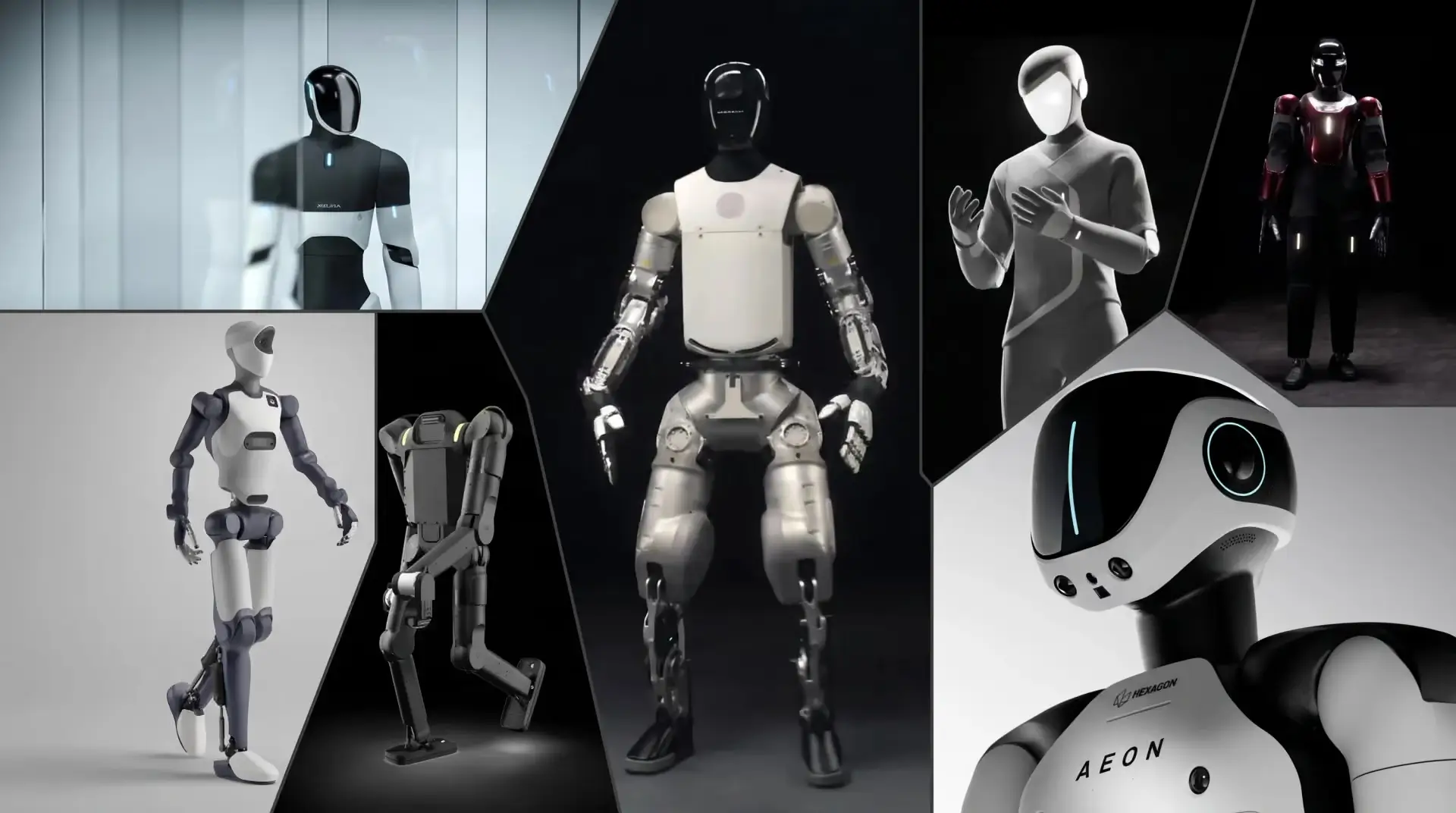
I have been looking at the new generation of humanoid robots emerging across Europe, US, and China. I keep coming back to the same uncomfortable thought, the problem is not that we are bad at building humanoids. We have become too good at optimizing a body we never stopped to question.
Robots are learning to walk, balance, manipulate objects, navigate complex environments and increasingly perform useful tasks. Companies such as Neura Robotics, Agile Robots, Humanoid, Hexagon Robotics, Generative Bionics are pushing Physical AI forward from different directions. Yet, despite all this technological diversity, the visual and morphological language remains remarkably convergent with a typical torso, pelvis, two arms, two legs and some approximation of a head. The intelligence is changing rapidly. The body is changing much slowly.
There is a legitimate reason for this. Modern robotics inherited a powerful academic tradition built around questions such as locomotion, whole-body control, manipulation, reinforcement learning, perception and sim-to-real transfer. These are important and difficult problems, and they have produced extraordinary advances. But academic research also shapes the questions that the industry subsequently asks. A researcher can spend years developing a new locomotion or manipulation architecture because its performance can be measured, benchmarked and published. The robotics community has been solving the problem of how to make a humanoid intelligent, rather than asking what body an intelligent machine should have.
Venture capital and market dynamics add another layer. A humanoid is immediately understandable. Two arms, two legs and a head communicate the category instantly. That makes the concept easy to explain to investors, media and customers. But category recognition can also become a constraint. Once “humanoid” becomes an investment category, companies have an incentive to look humanoid enough to belong to it. We may therefore be witnessing an unusual phenomenon like some of the world’s most advanced AI systems are being placed inside one of the most conservative body concepts imaginable.
This is where I think the conversation needs to become much broader. What happens when sensing is distributed throughout the body? When actuation becomes integrated into structure? When the skin is simultaneously an interface, sensor and computational substrate? When computation is no longer concentrated in a central processor but distributed across the physical system?
At that point, the body itself becomes part of the intelligence. The first generation of Physical AI will be remembered for teaching machines to behave more like humans. The more consequential generation may be the one that discovers forms of physical intelligence beyond the limits of the human body.