
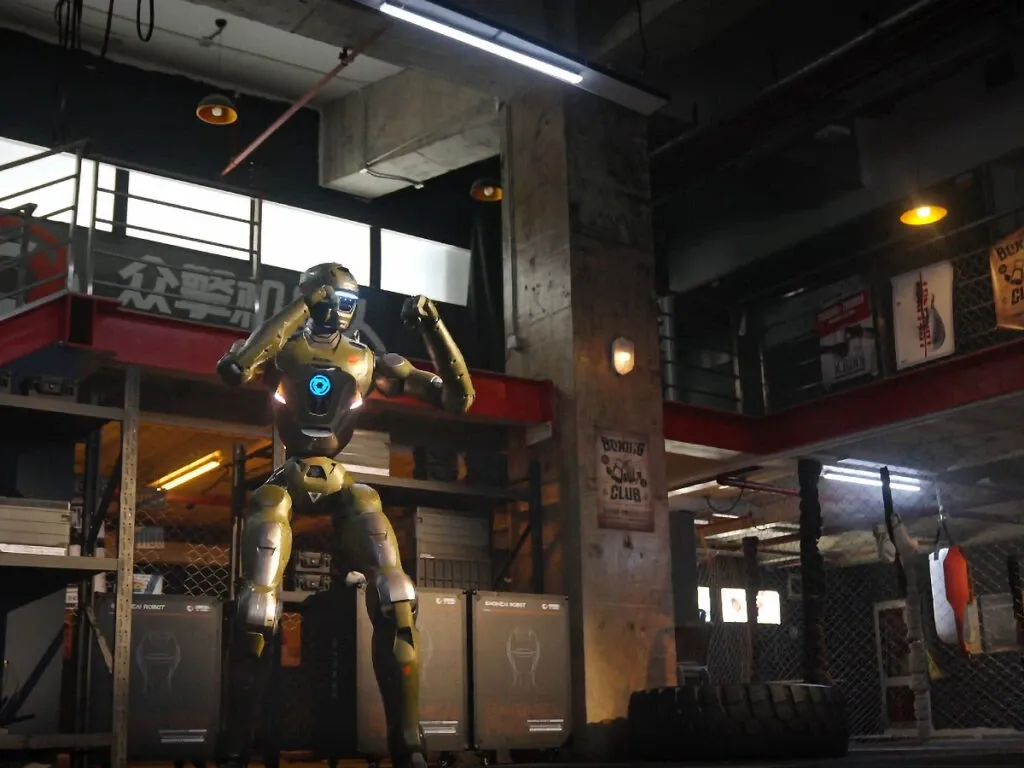
Humanoid robots are progressing in a direction that many people find increasingly unsettling. They were introduced as helpers but many of today’s designs look more like the early prototypes of future soldiers.
EngineAI’s T800 performs fast kicks, jumps, and martial-arts-style movements, the body language of a fighter, not a service robot. Midea’s MIRO-U comes with six robotic arms and high-speed wheels, built for superhuman reach and force. Foundation Robotics is openly discussing large-scale production and a long-term vision of armed humanoids. Unitree’s H1 keeps breaking speed and agility records, moving like an elite athlete instead of a shop-floor assistant. Tesla’s Optimus Gen-2 is gaining strength, precision, and autonomy that could be applied far beyond safe home tasks. Figure’s Figure 01 is being shaped for high autonomy and high output capabilities that can be redirected with small tweaks. Fourier’s GR-1 is already entering mass production, meaning thousands of units could be deployed rapidly.
These are impressive achievements, but they raise a serious question. Are we building the foundations of the next global conflict, where humanoids will be deployed at scale for chaos and destruction? When humanoids become stronger, faster, and cheaper, nations will not ignore the strategic advantage. History is clear, every major technology like aircraft, satellites, drones, and AI eventually entered or was intended for military use. Humanoids will follow the same path much faster because their form factor already matches human tasks, human tools, and human terrain.
The problem isn’t the robots. The problem is the hidden human intent and the development trajectory. Most public demos highlight speed, power, combat-like motion, superhuman abilities. Very few highlight safety, trust, ethics, peaceful collaboration or even simple human joy. This shift makes people uneasy. It looks like we are quietly normalizing humanoids as aggressive machines that may one day take part in conflicts between world superpowers.
Bottom Line
We need a clear global vision, one that prioritizes safety, peaceful uses, shared standards, and international cooperation. Without this, the humanoid industry will slip fully into a new arms race that no one intended or can fully control. Now is the moment to choose the right path.