
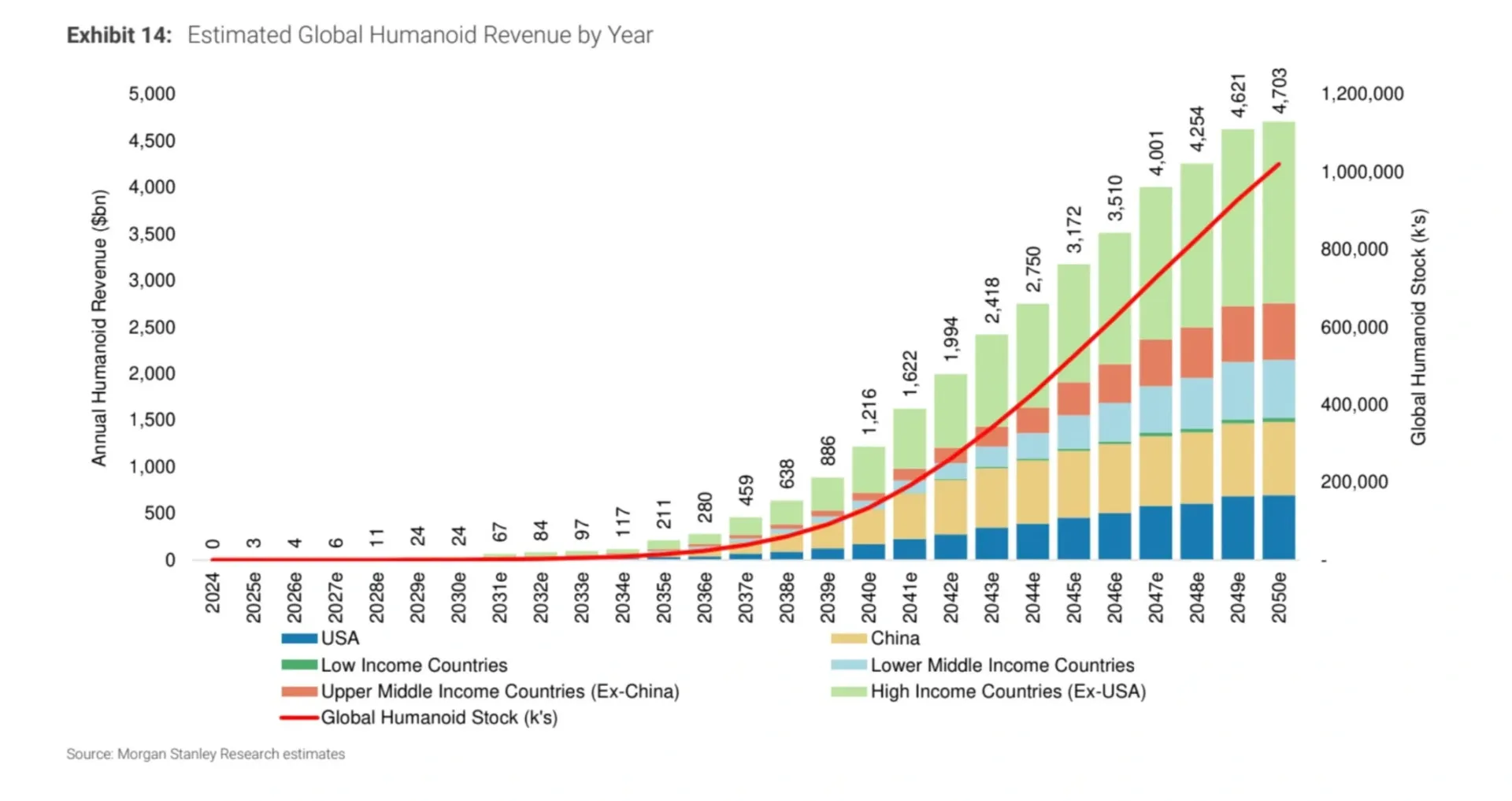
Global banks and renowned consulting firms are publishing very bullish humanoid robot forecasts. Morgan Stanley talks about 1 billion humanoids by 2050. Goldman Sachs expects a $38B market by 2035. BCG says humanoids may become “as common as smartphones.” ARK Invest says humanoids will “replace most manual labor.” These forecasts sound exciting. But they ignore engineering reality, manufacturing constraints, and actual adoption data. They repeat the same mistakes made during the 3D printing bubble, drone bubble, blockchain bubble, and autonomous driving bubble.
Adoption is overestimated. There are only 3.9 million industrial robots in the world today (IFR 2024). Adoption grew at ~10% CAGR over 10 years. Expecting 1 billion humanoids means a 250× leap in a far harder category.
Costs won’t drop as fast as predicted. Today, humanoids cost roughly $40–60k for Tesla Optimus (internal estimate), around $150k for Figure, and about $90k for Unitree H1. Many reports assume humanoids will hit $10k quickly. This is unrealistic without real and radical breakthroughs.
Reliability is nowhere near enterprise-ready. Industrial robots achieve 99.9% uptime. Humanoids today often achieve <50% success rates on real tasks. No safety certification frameworks exist yet.
Energy consumption is ignored. A humanoid needs 30–60× the energy of a human for equivalent physical work. Factories and warehouses would need major infrastructure upgrades. None of the reports include this.
Reports recycle and copy-paste the same assumptions from each other. Most forecasts use the same data and the same “S-curve” narrative. This creates an echo chamber, not independent and pragmatic research.
Here is a more grounded forecast of humanoids which is far below the 1 billion figure, but still a massive opportunity.
2030: 100k–300k units
2040: 5–10 million units
2050: 50–100 million units
A word of caution
Investors, don’t rely on glossy figures. Demand deployment data, maintenance cost curves, and real ROI not narratives. Startups, don’t build hype. Build original hardware, new designs, and real engineering, stop copy-pasting. Corporates, pilot before you scale. Evaluate cost vs. uptime, not cost vs. human labor. Government policymakers, don’t shape national priorities and policies based on speculative forecasts.
The real winners will be the companies building the deep foundations, intelligent components, advanced actuators, next-generation batteries, high-resolution sensors, AI control stacks, and breakthrough materials. The losers will be those selling hype, recycled designs, and empty promises.
Bottom Line
Humanoids are coming but not because of glossy forecasts. They will advance through rigorous engineering, reliable AI, and real-world performance, not hype.