
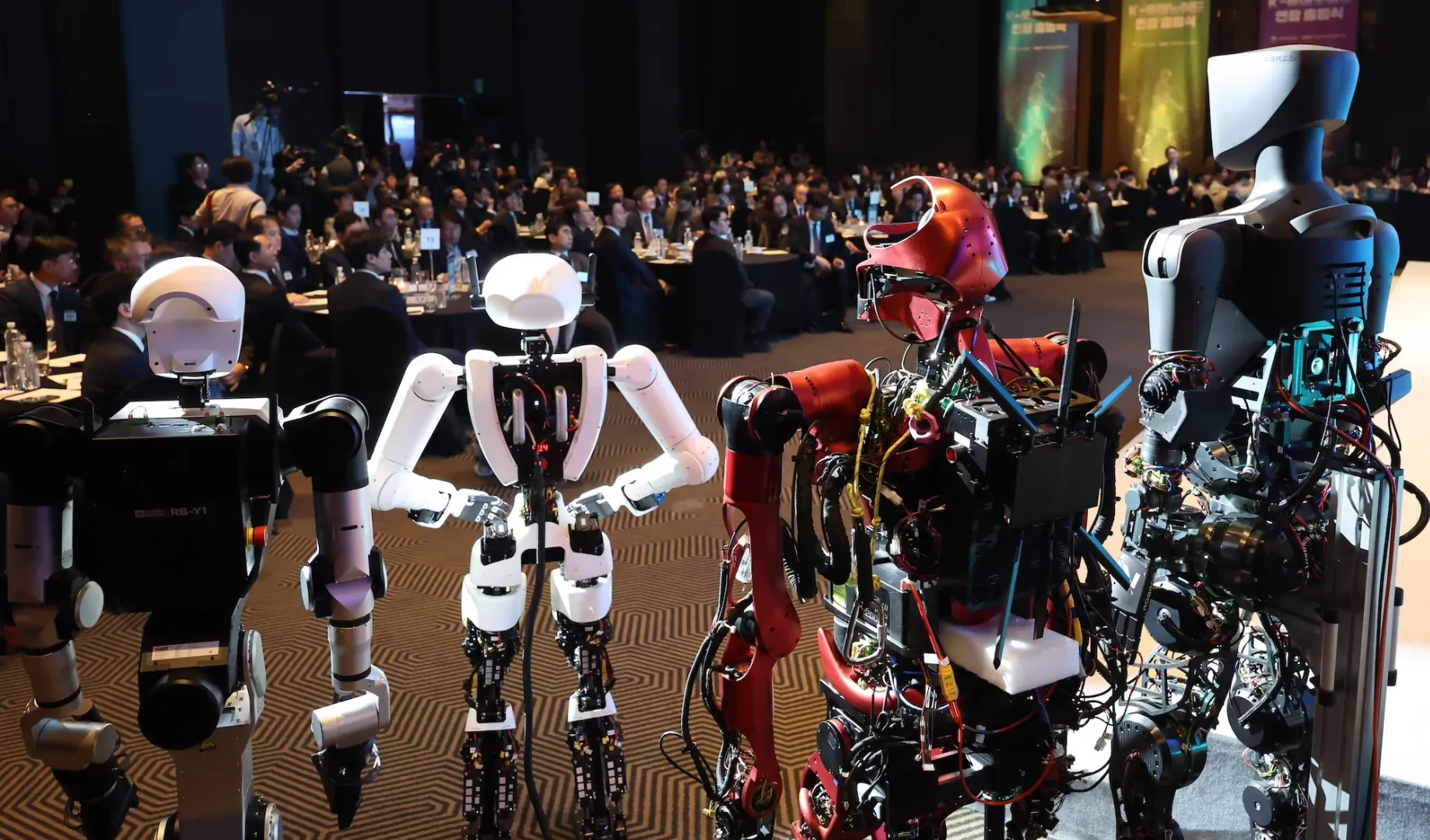
South Korea, China, and Japan have each launched major alliances to accelerate humanoids. Humanoids are becoming national priorities.
South Korea launched the K-Humanoid Alliance and MAX Alliance. Members include SNU, KAIST, POSTECH, Korea University, Yonsei University, Rainbow Robotics, Doosan Robotics, HD Hyundai Robotics, Neuromeka, Robotis, Angel Robotics, A Robot, Holiday Robotics, Blue Robin, Samsung SDI, SK On, LG Energy Solution, DEEPX, Samsung Display, Samsung Heavy Industries, CJ Logistics, and POSCO. Their objective is to build a full humanoid tech stack and deploy in manufacturing, logistics, and daily life by 2030.
China has formed Standardization Technical Committee for Humanoid Robots and Dream Team Committee led by government body, and founders of its top robotics companies. Members include Unitree Robotics, AgiBot, Xiaomi, Huawei, ZTE, XPeng, Tsinghua University, and Shanghai Jiao Tong University. China’s strategy is simple i.e. set standards early, so every humanoid in the country follows unified rules for safety, hardware, and data.
Japan, once the global leader in humanoids, is restarting its push through KyoHA (Kyoto Humanoid Association). Members include Waseda University, Murata Manufacturing, tmsuk, SRE Holdings, and Renesas Electronics. Their ambition is to build and mass-produce fully Japanese made humanoids by 2027.
These types of alliances aren’t new, and they have failed in the past.
There were similar alliances in the past for robotics, and most struggled to deliver meaningful results. Conservative approaches slowed decision-making and stifled bold experimentation. Limited integration of global talent led to inward-looking development. Teams worked in silos, with minimal knowledge-sharing or joint roadmaps. Universities, corporations, and government agencies often pursued mediocre and misaligned goals. Funding cycles were short-lived, ending before prototypes could mature. Early prototypes rarely scaled into commercial products. Meanwhile, technology advanced faster than alliances could respond. These failures were not due to a lack of capability, but a lack of coordination, culture, and long-term commitment. To avoid repeating past mistakes, the new alliances must prioritize common standards, long-term investment with meaningful and sustained funding, deep public–private collaboration, real-world use cases from day one, cultivating global leaders rather than local talent alone, transparent governance and accountable decision-making.
Bottom Line
The humanoid superpower won’t be the country focused on alliances, it will be the one that builds the right ecosystem, driven by visionary leadership, global talent, a creative culture, exceptional teamwork, and seamless coordination.