In an ancient land,
a village stood
among the hills.
Far beyond the hills
flowed a hidden
spring of water.
The journey
to the spring
was difficult.
So the first people
who found it
left directions.
They marked trees,
stacked stones,
and recorded
the path.
The directions
were treasured.
Not because
they were valuable.
But because
they led to
something valuable.
And whenever
thirst came,
people followed them.
And drank.
Generations passed.
The spring remained.
The directions remained.
But fewer people
made the journey.
Eventually,
no one alive
had seen the spring.
Though everyone
had the directions.
They were
taught in schools.
Displayed in halls.
Studied by scholars.
Protected by guardians.
Admired by all.
Then came
a great drought.
The river shrank.
The wells fell low.
Fear spread
through the village.
The scholars interpreted.
The teachers explained.
The guardians reassured.
The villagers listened.
Yet the thirst remained.
One day, a boy
listening quietly asked,
“Has anyone gone
to the spring?”
The room fell silent.
At last,
a scholar replied,
“The directions tell us
everything we need to know.”
The boy asked again.
“Yes. But has anyone
gone there?”
No one answered.
The next morning,
he left alone.
At last,
he found the spring.
The water flowed
exactly where
it always had.
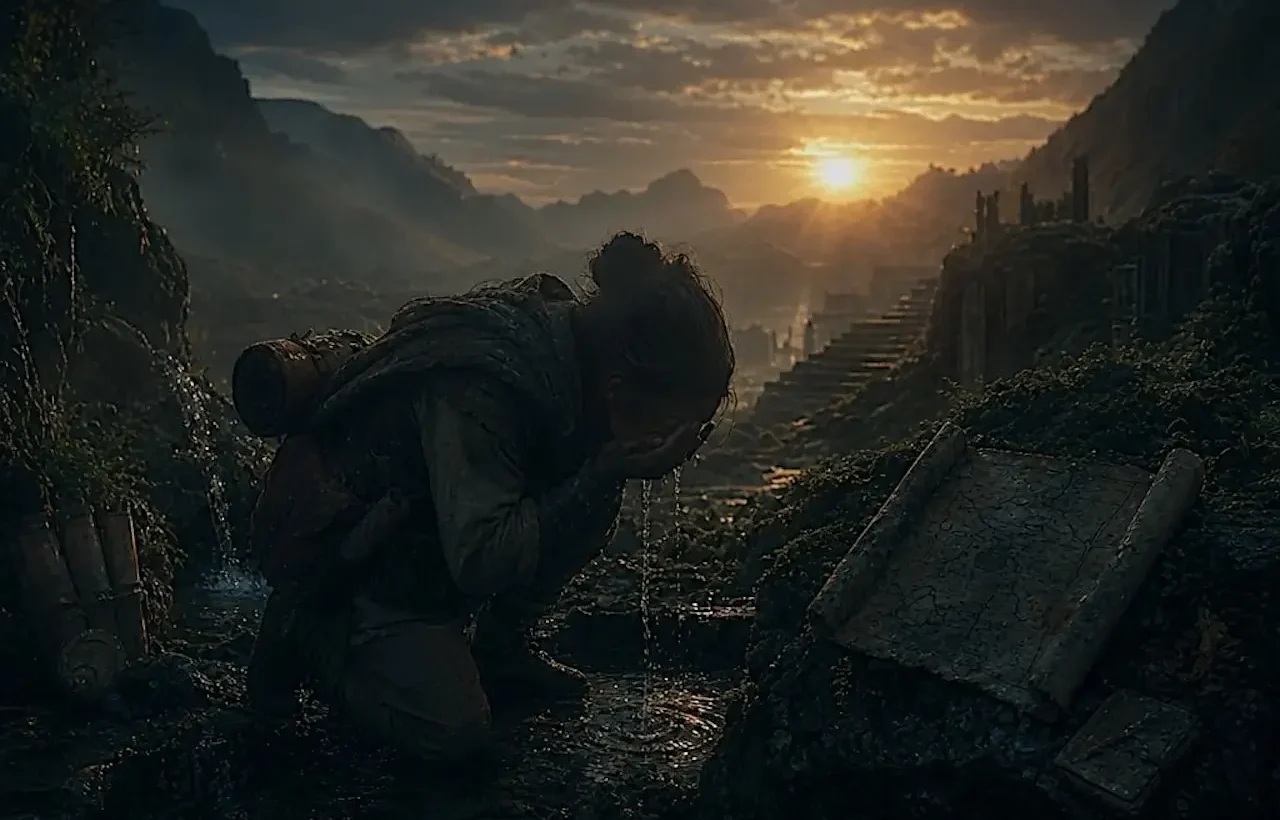
He knelt.
And drank.
When he returned
carrying water,
joy swept
through the village.
The spring was real.
The directions had been
true all along.
People began making
the journey again.
The drought no longer
frightened them.
Years passed.
The boy became
an old man.
Near the end
of his life,
the villagers asked
what wisdom
he had gained.
For a long while
he said nothing.
Then he spoke.
“When I was young,
I thought
the greatest danger was
forgetting the spring.”
The villagers nodded.
“I was wrong.”
He pointed toward
countless copies
of the directions.
Then toward paintings
of his journey.
Then toward a statue
of himself
standing in the heart
of the village.
“When I returned,
people stopped arguing
about the directions.”
A faint smile
crossed his face.
“They began arguing
about me.”
The room grew still.
“Some copied
my words.”
“Some copied
my footsteps.”
“Some copied
the container
I carried.”
Then he looked
at the child
nearest him.
“But very few
copied the one thing
that mattered.”
Then a child asked,
“What was that?”
The old man answered,
“I drank.”
The room was silent.
At last he said,
“The spring never asked
to be worshipped.”
“It only asked
to be tasted.”
Those were
his final words.
Years later,
a traveler passed
through the village.
He saw
books about the old man.
Paintings of the old man.
Statues of the old man.
And people debating
what the old man
truly meant.
Finally, he asked
a young girl,
“Do people still go
to the spring?”
The girl thought
for a moment.
“Some do.”
The traveler smiled.
“That is enough.”
And he continued
on his way.
For the spring was
never in danger.
Only the thirsty were.

Manoj Sahi Kumar
Deep-Tech Systems & Commercialization Leader advancing frontier technologies shaping civilization
Physical AI, Humanoids, Robotics & Autonomous Systems · Advanced Materials · Energy Transition
Available for select opportunities
Spring, Thirst, Taste
–
by