
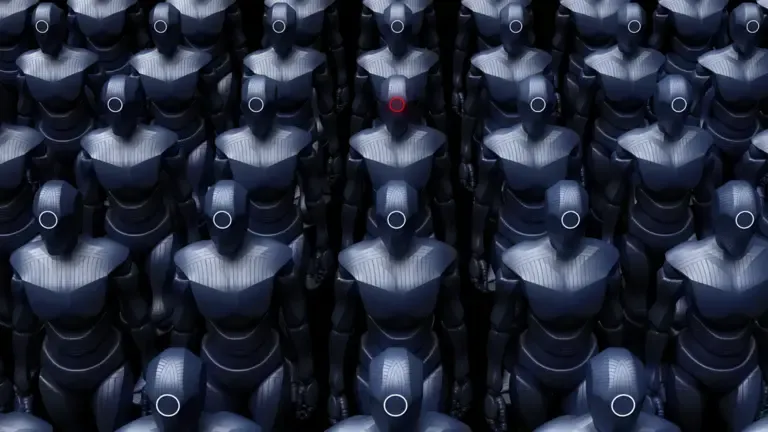
Humanoid robotics is crossing a strategic threshold. As machines replace humans in contested environments, the foundations of deterrence and ethical restraint begin to shift. By 2030, credible forecasts place the humanoid market above $50 billion. Governments are driving much of this growth. Military and dual-use robotics spending already exceeds $20 billion annually, growing over 15% CAGR. The motivation is not novelty, but endurance, speed, and reduced human exposure. China installs over 50% of the world’s industrial robots each year and is extending this advantage into humanoids through state funding. The United States leads in advanced AI models and semiconductors, while China leads in deployment speed and scale. Europe, India, and other middle powers are accelerating development to avoid dependency.
In a multipolar world, deterrence is harder and red lines are unstable. Humanoid and autonomous systems deepen this uncertainty. Classical deterrence relied on shared human vulnerability. Nuclear stability endured because escalation meant unacceptable human loss. Humanoids erode this logic. Machines absorb risk. Domestic political pressure falls. The threshold for force drops. Moral hazard follows. When war appears cleaner and controllable, restraint weakens. Conflicts persist as human cost is delayed. Risk does not vanish. It is deferred.
Data reflects this shift. Over 90% of military reconnaissance now relies on unmanned or autonomous systems. Decision cycles that once took hours now unfold in minutes or seconds. As autonomy rises, escalation timelines compress especially in a multipolar world. Regional conflicts overlap, and systems follow different doctrines and ethical standards. A humanoid used for logistics or security in one theater may be read as offensive in another. Escalation can occur without intent. Speed amplifies risk as autonomous systems act faster than human judgment, and a sensor error or adversarial input can trigger action before intervention. Cold War history shows human hesitation often prevented catastrophe. Machines do not hesitate.
There is an ethical fracture. Delegating lethal authority erodes meaningful human control. Accountability diffuses across code, data, and command chains. When responsibility blurs, legitimacy collapses. International humanitarian law is falling behind. The deeper risk is normalization. Humanoids make force appear manageable, reversible, and precise. This illusion is destabilizing. The future will not be decided by who builds the most advanced machines, but by who governs them best. Shared norms, firm limits, and human accountability are no longer optional.
Bottom Line
When humans no longer bear risk, war becomes easier to start, harder to stop, and unchecked humanoid autonomy destabilizes the world.