
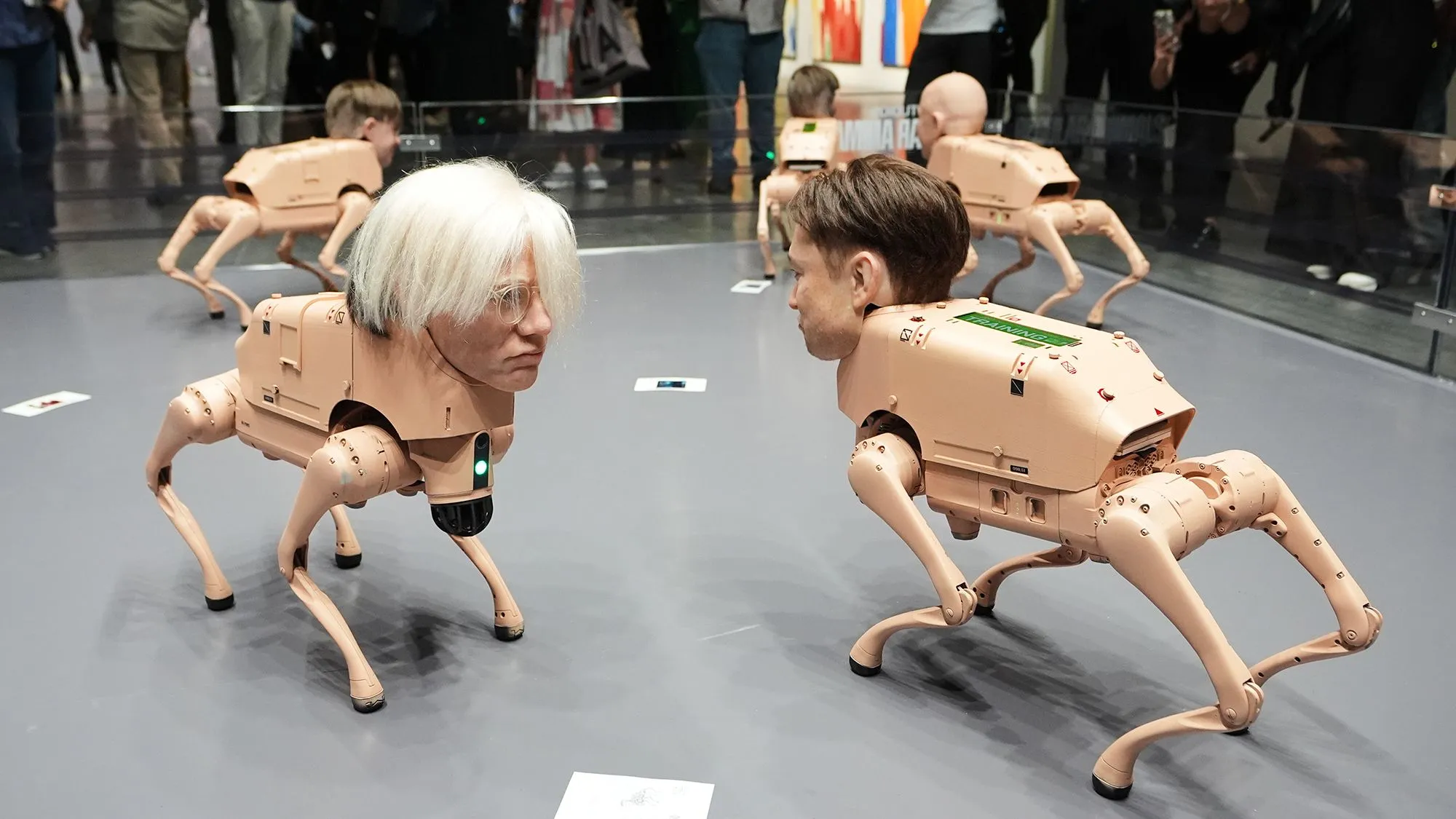
In the chaos of Art Basel Miami Beach 2025, one installation didn’t just catch eyes, it stopped people. At the heart of the Zero 10 digital art sector, acclaimed digital artist Mike Winkelmann (Beeple) released a pack of autonomous robot dogs that showed what art can perform, provoke, and produce.
These are not your average animatronics. Imagine a pack of quadrupedal robots, wearing hyper-realistic silicone heads of Elon Musk, Jeff Bezos, Mark Zuckerberg, Andy Warhol, and even Picasso. They roam a penned space at the fair, pausing to photograph visitors with built-in cameras. Then, with an LED blinking “POOP MODE,” they release printed images from their rear ends.
At first glance, the spectacle is absurd, comical even. But that is precisely the point. “Regular Animals” by Winkelmann blends satire, anxiety, and sharp insight into our age of algorithmic control. By placing the faces of billionaire tech moguls on robotic dogs, he turns the gaze back on those who shape the lenses through which we view the world. These robots literally see and reframe what is in front of them, producing art informed by styles associated with each persona, while the public becomes both subject and audience.
The metaphor feels timely. Our digital lives increasingly wind through corporate algorithms, customized feeds, tailored recommendations, curated worldviews. What if the creators of those algorithms were the ones interpreting reality for us? What stories would they print out? What truths, or distortions, might spill from behind the veneer of hyper-real tech cool?
And yet, the humor is unmistakable. The robots “pooping” art is intentional. They produce printed, physical pieces. It highlights how unpredictable culture has become. It also shows how value and meaning are shaped today. Virality, technology, and status often matter more than merit.
Visitors film, laugh, recoil, and collect. Some call it terrifying. Others call it brilliant. But in a world drowning in digital noise, that reaction is the art. The art world no longer sits solely in galleries filled with oil and canvas. It now lives in interactivity, robotics, and AI, the very technologies transforming how we work, think, and connect. It is a paradox wrapped in irony. The work is simultaneously material and immaterial, much like our daily digital experiences.
Bottom Line
In the end, the robot dogs do not just make art. They pose a question. In an age where seeing is believing, who decides what we see and how deeply we trust it? And when machines begin to create art, what does that say about authorship, power, and control? The future is already here. And sometimes, it barks back at us.