
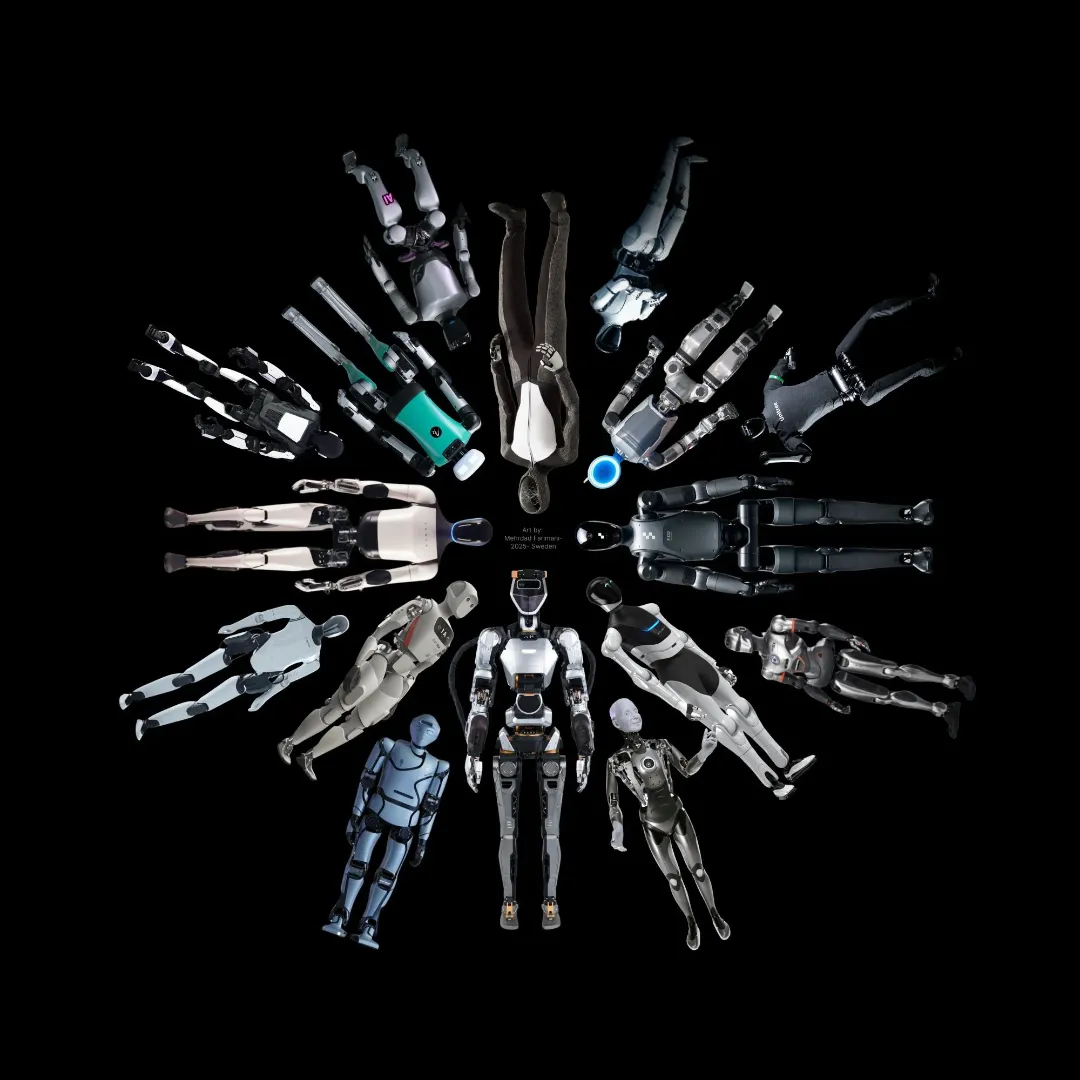
Not because the designers and engineers lack talent, but because their starting assumptions are flawed and the vision of the future they’re pursuing is far too narrow.
We keep building humanoids that look impressive, walking, waving, stacking, mimicking human gestures. We celebrate videos of a robot taking careful steps or delicately picking up a lightweight object and then quietly avoid the hard questions. Why does it burn kilowatts of power to do what a human does at ~100 watts? Why does a minor push or misstep lead to a catastrophic fall instead of a safe recovery? Why is the system optimized for a few-minute demo, not for hours of real work in a messy environment?
Human anatomy is not an engineering blueprint. It’s an evolutionary compromise. Yet many humanoids today inherit the worst parts of that compromise. Full-time bipedal walking, even on flat factory floors where wheels would outperform legs by orders of magnitude. Five-fingered hands attempting human dexterity, while industrial work is almost always tool-mediated. Perfect symmetry, because it looks human, even though most real tasks are asymmetric. Dozens of active degrees of freedom, creating fragile control stacks that collapse outside ideal conditions. This is how we end up with robots that look capable and are economically useless.
A non-stupid humanoid design starts from first principles. Energy is the primary constraint → walk only when topology demands it, roll whenever possible. Stability beats dexterity → fewer DOF, more force awareness, predictable contact. Asymmetry is functional → one arm stabilizes, the other acts. Tools over imitation → robots should become tools, not copy hands. Failure is normal → fall safely, self-right, degrade gracefully.
If a humanoid can’t operate for hours, fail, and recover autonomously, it’s not a reliable system, it’s only a performance. There’s also a deeper issue we rarely discuss, power asymmetry. A human-shaped machine that can move autonomously, lift weight, observe continuously, and operate without fatigue is not neutral. Height, posture, gaze, speed, and voice encode authority and control, whether we intend it or not. Architecture is policy, frozen in hardware. And finally, many humanoids default, unintentionally to masculine proportions, voices, and behaviors. A robot does not need gender, dominance, or intimidation to be effective. Those are social choices, not technical necessities.
Bottom Line
The future won’t be won on stage, but by better humanoid designs that are energy-honest, reliable, failure-tolerant, socially legible, and culturally aware. Leadership in humanoid robotics isn’t about doing everything we technically can, it’s about having the judgment to say NO to designs that are fundamentally stupid!