
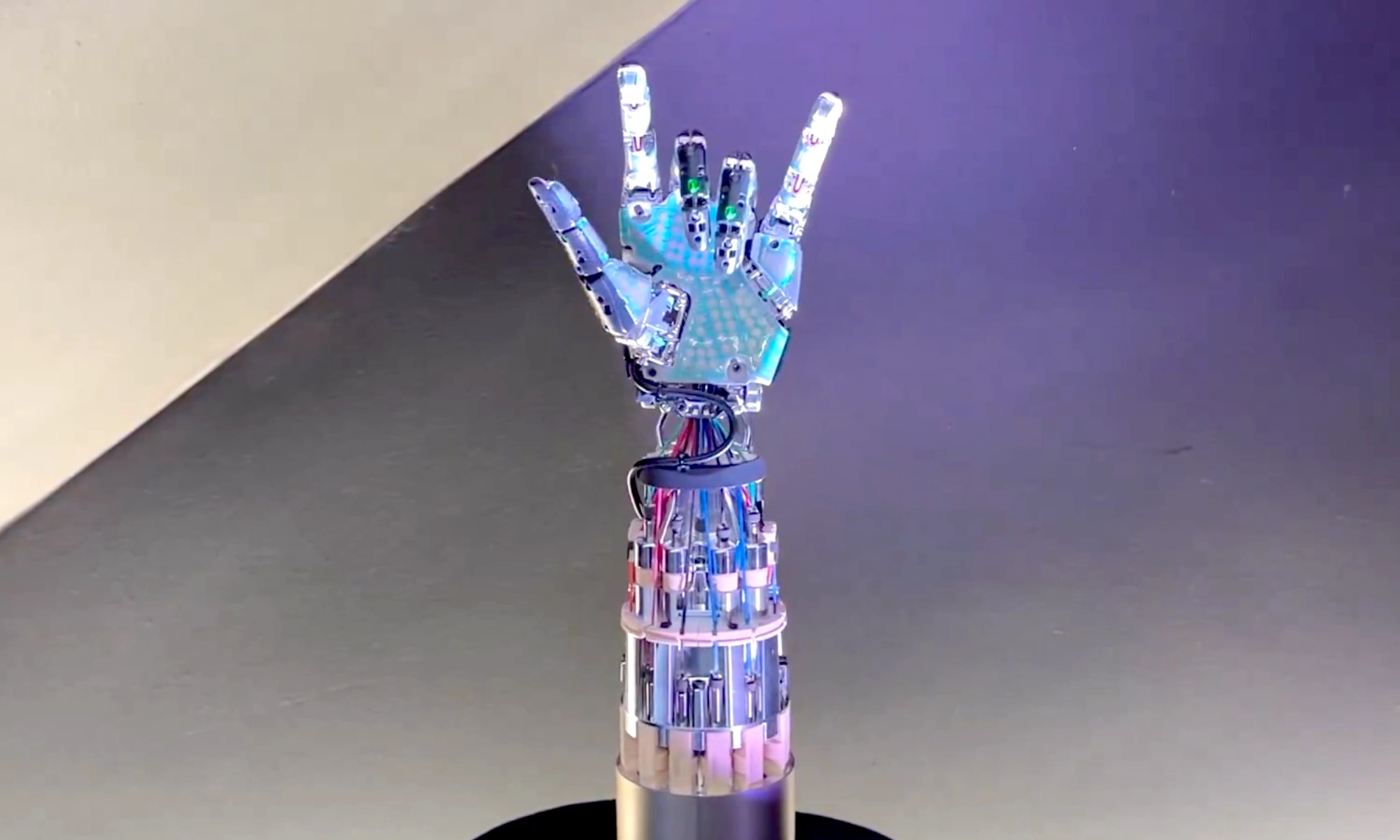
In mature engineering fields, progress shows up as elegance. In hype cycles, it shows up as part counts. Across the robotics industry, announcements about next-generation robot hands increasingly highlight how many actuators, joints, or degrees of freedom fit into a wrist. These numbers are presented as signals of progress. But in robotics, this kind of specification often means something else entirely. The hard problems remain unsolved, so the narrative shifts toward visible hardware escalation. When a design story revolves around component counts rather than what architectural problem is being solved, it suggests uncertainty disguised as ambition.
Dexterity does not emerge from abundance. The human hand is not remarkable because it contains many muscles, but because those muscles operate as a coordinated system governed by sensing, prediction, and control. Biological dexterity is an information problem before it is a mechanical one. Robotic systems that add actuator after actuator without equivalent advances in sensing and control are not becoming more capable, they are becoming more complicated. Every additional motor increases power demand, heat, wiring density, control latency, and failure probability. Complexity compounds faster than capability.
The central constraint in robotic manipulation today is not articulation. It is interaction under uncertainty. Robots fail at simple household tasks not because they lack joints, but because they cannot feel, predict, and adapt the way humans do. Grasping a soft object, stabilizing a shifting load, or handling a slippery surface requires continuous micro-adjustments driven by touch. Without that sensory intelligence, a highly articulated hand becomes mechanical theater.
There is also the issue of engineering maturity. Densely actuated hands are among the most difficult systems in robotics to build reliably. Precision miniaturized actuators that combine high torque, low weight, durability, and affordability remain an unsolved industrial challenge. For systems intended to scale beyond research labs, this is not progress.
Meanwhile, much of serious robotics research has been moving in the opposite direction. Many advanced hands intentionally use fewer motors than joints, relying on tendon routing, under-actuation, and passive compliance so fingers naturally conform to objects. This “mechanical intelligence” allows physics to share the burden with software, reducing computational overhead while increasing robustness.
Bottom Line
When systems intelligence is hard, hardware metrics become the spectacle. But robotics does not reward actuator accumulation. It rewards coherence, predictability, and reliability built on sensing density, adaptive control, and mechanical elegance.