The Current and Emerging Architectures of Physical Intelligence
The evolution of Physical Intelligence is bringing together perception, physical reasoning, and dexterous action to create machines that can understand, interpret, and interact intelligently with the physical world. Its emergence will not depend on a single model, robot, or computational architecture, but on the convergence of perception, physical representation, predictive cognition, transferable learning, mechanical embodiment, and continuous interaction.
Together, these capabilities are laying the foundations for a new generation of intelligent machines that can understand their surroundings, reason about physical reality, adapt across environments, and translate intelligence into purposeful action. The most defining advances may therefore come not from increasingly impressive humanoid demonstrations, but from the less visible, more fundamental technologies that establish a reliable relationship between intelligence and the physical world.
Artificial intelligence has made extraordinary advances in processing language, recognizing images, generating content and reasoning across increasingly complex digital environments. Yet the ability to understand, predict and interact reliably with the physical world remains a substantially more difficult scientific and engineering challenge. A machine may recognize an object without understanding its mechanical properties, predict an action without possessing the ability to execute it, or generate a plausible movement without having the sensory feedback necessary to correct its mistakes. The transition from computational intelligence to physical intelligence therefore involves considerably more than transferring increasingly sophisticated AI models into robotic bodies. It requires the development of systems capable of perceiving physical conditions, constructing meaningful representations of the environment, predicting the consequences of actions, learning from interaction and adapting their behavior to the constraints of reality.
This transition is beginning to take shape through several converging research directions. Tactile foundation models are exploring representations that can transfer across different sensing technologies. World-action models are attempting to predict environmental changes alongside the actions that produce them. Simulation-generated experience is reducing the dependence on expensive real-world demonstrations, while human-to-robot learning is investigating how knowledge acquired through human activities can be translated into executable robotic skills. At the same time, advances in dexterous manipulation, compliant mechanisms, artificial muscles, intelligent materials and distributed robot evaluation are expanding the physical and computational foundations of the field.
These developments are significant, but they should not be mistaken for the arrival of general-purpose physical intelligence. The distance between demonstrating a capability and establishing a dependable system remains considerable. Long-horizon manipulation, cross-embodiment transfer, contact-rich reasoning, energy efficiency, mechanical durability, safety and operational reliability continue to present challenges.
This work examines the emerging architecture of Physical Intelligence through its scientific foundations, experimental developments and industrial applications. It evaluates the maturity of representative technologies, identifies the constraints separating research progress from practical capability, and proposes a systems-level framework for understanding the next generation of intelligent machines.
01. Rethinking the Meaning of Physical Intelligence.
The development of artificial intelligence has largely followed a trajectory in which information is represented, processed and transformed within computational environments. Language models learn statistical relationships between linguistic concepts. Vision models extract representations from images and video. Multimodal systems increasingly combine different information sources to interpret and respond to complex inputs. These advances have established powerful computational capabilities, but physical intelligence introduces a fundamentally different requirement. Intelligence must operate within an environment governed by physical laws, where actions produce consequences that cannot simply be reversed by generating a different output.
A machine interacting with the physical world must contend with mass, inertia, gravity, friction, deformation, temperature, contact forces, mechanical resistance and uncertainty. Unlike digital information, physical interactions are constrained by material properties, energy availability, geometry and time. An incorrect prediction can result not merely in an inaccurate answer, but in a damaged component, a dropped object, a collision or a failure of an entire process. The environment is also continuously changing in response to the machine itself. Physical intelligence must consequently involve a continuous relationship between observation, internal representation, prediction, action and feedback.
Consider the seemingly simple task of handling a glass. A conventional vision system may recognize the object and estimate its position. A more capable perception system may estimate its geometry and orientation. However, reliable physical interaction requires considerably more. The machine must infer the object’s approximate weight and fragility, determine an appropriate grasp, regulate applied force, detect the onset of slipping, compensate for movement and release the object without damaging it. If the glass contains liquid, the robot must additionally account for changes in its centre of mass and the dynamics of the contents. The capability to recognze the glass is therefore only the beginning of the problem.
This distinction can be expressed through four progressively demanding capabilities including recognition, physical understanding, executable action and reliable autonomous performance. Contemporary AI systems are becoming increasingly capable in the first two, while the latter two remain active areas of research. The distinction is important because a machine that produces a plausible action is not necessarily capable of executing it, and a machine that occasionally executes an action successfully has not necessarily acquired a dependable physical capability.
Physical Intelligence should therefore be understood as the capacity of an intelligent system to acquire and maintain useful representations of physical environments, predict the consequences of interaction, and execute adaptive actions under real-world constraints. This definition is broader than humanoid robotics, embodied AI or autonomous machines. It includes any system in which intelligence is grounded in physical interaction, whether that system is a humanoid, mobile manipulator, industrial robot, autonomous vehicle, soft robotic device or adaptive material-based mechanism.
02. The Distinction Between Intelligence and Embodiment.
The growing association between Physical AI and humanoid robotics risks obscuring an important engineering distinction. A humanoid is a particular morphological configuration, not a universal definition of physical intelligence. Its human-like structure can provide advantages when interacting with environments designed around human reach, tools, workstations and movement. However, bipedal locomotion, anthropomorphic hands and human-scale proportions also introduce mechanical complexity, energy requirements and additional control challenges.
A wheeled manipulator may be considerably more effective for moving materials through a warehouse. A fixed-base dual-arm robot may provide greater stability and precision for repetitive assembly. A compliant gripper may outperform a dexterous anthropomorphic hand when handling fragile or deformable objects. A specialised autonomous vehicle may possess sophisticated physical intelligence without having anything resembling a human body.
Recent industrial developments illustrate this diversity. HD Hyundai Robotics is exploring a wheeled dual-arm architecture for industrial tasks, while the EPFL spin-off Embodied AI has introduced AIR, a mobile two-arm platform designed to work alongside factory personnel. NYU’s MABEL research platform combines mobility, adjustable reach and bimanual manipulation in an open-source system. ASUS, by contrast, is developing Gallop around an existing electronics-manufacturing workstation, where human-compatible manipulation is intended to reduce the need to redesign the factory environment.
These approaches suggest that intelligence and embodiment should be treated as interconnected but distinguishable design dimensions. The optimal body depends on the physical task, the environment, the available energy, the required precision and the economics of deployment. A universal intelligence architecture, if one eventually emerges, may therefore operate across a heterogeneous population of machines rather than being confined to a single humanoid platform.
The question is not whether machines will eventually look human, but whether they will acquire transferable capabilities for understanding and interacting with the physical world, independently of the particular mechanical form through which those capabilities are expressed.
03. The Emerging Architecture of Physical Intelligence.
The architecture of Physical Intelligence is best understood as a system of interdependent capabilities rather than a conventional software stack. Perception, physical representation, predictive reasoning, learning, embodiment and execution cannot be developed entirely independently because each influences the others. A robot’s sensory configuration determines what it can observe, its morphology determines which actions it can perform, its internal representation determines what it can infer, and its interaction with the environment generates new information that modifies subsequent behavior.
A useful conceptual architecture contains six interconnected layers. These are sensory perception, physical representation, predictive cognition, learning and adaptation, embodiment and execution, and operational intelligence. These layers are not intended as a prescribed implementation or a claim that all systems must contain six separate models. They provide a framework for identifying the functions that a capable physical intelligence system must eventually integrate.
04. Sensory Perception: Beyond the Dominance of Vision.
Vision has become the dominant sensory modality in contemporary AI and robotics because cameras provide rich information about objects, spatial relationships, human activities and environmental conditions. Large-scale visual datasets have also created an opportunity to transfer knowledge from general-purpose computer vision into robotic applications. However, vision alone cannot provide all the information required for reliable physical interaction. A camera can reveal the approximate shape of an object, but it cannot always establish its internal structure, stiffness, weight distribution, friction coefficient or resistance to deformation.
Physical interaction therefore requires a substantially richer sensory architecture. Tactile sensors provide information about contact geometry, pressure distribution and local deformation. Force and torque sensors reveal the mechanical consequences of an action. Proprioceptive systems estimate the configuration and movement of the robot’s own body. Acoustic and vibration sensing can help identify contact events, mechanical conditions and changes in material behavior, while thermal sensing can contribute information about environmental and material states. These modalities become particularly important when the robot interacts with objects whose physical properties cannot be inferred reliably from appearance alone.
One of the most interesting developments in this area is Robbyant’s LingBot-Touch, introduced in November 2026 through the research paper Learning Heterogeneous Tactile Representation for General Dexterous Manipulation. The work addresses a fundamental limitation of existing tactile systems across different sensors operate through different physical principles and produce different forms of data. Piezo-resistive, magnetic and visuo-tactile sensors, for example, may observe related contact phenomena but encode them through different measurement mechanisms.
LingBot-Touch attempts to address this fragmentation through a shared tactile representation. Its reported pre-training corpus contains 4,983 hours of tactile recordings, approximately 464,000 interaction episodes and 1.33 billion frames. The dataset combines recordings from human-operated tactile gloves and tele-operated robotic hands. Its architecture uses modality-specific tokenization and a shared representation model to extract information from different sensing technologies. In experiments involving 26 real-world manipulation tasks, the authors report that integrating the learned tactile representation into four existing robotic policies improved success rates by 14 to 26 percentage points. The study also evaluates transfer to a sensor model not encountered during pre-training.
The significance of this work lies less in the scale of the dataset than in the attempt to separate the representation of physical contact from the particular sensor used to measure it. If tactile information can be represented in a form that remains useful across different hardware architectures, it may become possible to develop reusable tactile intelligence rather than repeatedly designing sensor-specific perception systems. Such a development could support more transferable manipulation policies, simplify hardware integration and reduce the cost of collecting tactile training data.
The result should nevertheless be interpreted carefully. The study demonstrates promising transfer across selected sensing technologies and robotic platforms, not universal tactile understanding. Sensor geometry, spatial resolution, calibration and physical measurement principles still matter. A shared representation may preserve some properties of contact while losing others. The research therefore establishes an important direction rather than a completed solution.
The larger opportunity is to develop a common physical representation that combines touch, force, deformation, proprioception and vision. A robot should eventually be able to infer not only that it is holding an object, but how securely it is holding it, how the object is responding to the applied force and what changes are likely to occur if the interaction continues.
05. Material Perception and the Physical Properties of Objects.
A further challenge is the ability to understand materials rather than merely identify objects. A robot may recognize a plastic container, a metal component or a fabric surface, but recognition does not automatically reveal the properties relevant to physical manipulation. Materials can vary significantly in stiffness, elasticity, friction, internal structure, thermal response and resistance to repeated loading. Even apparently identical objects may behave differently because of manufacturing tolerances, wear, moisture, temperature or deformation.
Material perception could become an important bridge between conventional computer vision and physical reasoning. A machine capable of estimating the likely mechanical behavior of an unfamiliar object could select an appropriate grasp, adjust its applied force and predict whether a proposed action is likely to damage the object. Such capabilities would be particularly valuable in recycling, manufacturing, logistics, food handling, healthcare and construction, where robots encounter objects with variable properties and incomplete descriptions.
This problem also connects Physical Intelligence to advanced materials research. The development of sensor-integrated materials, responsive surfaces and compliant structures could allow physical information to be embedded directly into the robot’s body. Rather than relying entirely on discrete sensors mounted on rigid components, future robotic structures may incorporate distributed sensing and adaptive mechanical responses. This creates an important research intersection between robotics, materials science, computational mechanics and machine learning.
06. Physical Representation: Constructing an Internal Model of Reality.
Perception provides observations, but intelligent action requires a representation of the physical state of the environment. A robot must estimate where objects are, how they are oriented, which surfaces are in contact, how forces are being transmitted and what physical constraints govern the situation. This representation must account for uncertainty because the robot rarely observes the complete state of the environment. Occlusion, sensor noise, deformation, unobserved forces and changing environmental conditions make exact physical reconstruction difficult.
A useful physical representation must therefore go beyond object recognition and conventional spatial mapping. It should incorporate geometry, material properties, motion, contact conditions, physical constraints and uncertainty. It should also distinguish between observed information and inferred information. For example, a robot may visually identify a box but remain uncertain about its weight. It can estimate that weight through prior knowledge, but it may need to perform a controlled lifting action to refine the estimate. The physical representation should update as new evidence becomes available.
This leads to the concept of a physical world model having an internal predictive representation of the environment and the consequences of possible actions. World models are increasingly being investigated as a way of connecting perception, prediction, planning and control. A September 2026 survey by Kirchner, Purschke and Knoll, published in Discover Artificial Intelligence, examines the role of uncertainty representation and control in world models for Physical AI. It identifies compounding prediction errors, uncertainty calibration, long-horizon consistency, physical constraint enforcement and safety as important unresolved problems.
These limitations are particularly consequential in physical systems. An inaccurate prediction may be tolerable when generating an approximate image or text response, but a small error in a robot’s estimate of contact position or object movement can cause an entire sequence of actions to fail. If a model predicts the movement of an object incorrectly, the next action may be based on an increasingly inaccurate representation. Errors can therefore compound over time.
The central research challenge is to develop world models that remain useful under uncertainty and continuously changing physical conditions. Such models should not merely predict plausible future images. They should represent the physical consequences of actions sufficiently accurately to support reliable decisions. This may require hybrid architectures combining learned representations with explicit physical constraints, geometric models, contact mechanics and conventional control methods.
07. Predictive Cognition: Learning How Actions Change the World.
The next architectural layer concerns the ability to reason about possible actions before executing them. A robot that understands the physical environment should be able to evaluate alternative actions, predict their likely outcomes and choose a strategy based on the desired result. This requires more than mapping instructions directly to movements. It requires an internal relationship between action and consequence.
NVIDIA’s GR00T 2, introduced in November 2026, provides an interesting example of this direction. The model is described as a foundation world-action model that predicts future video and robot actions together. Rather than learning only how to generate an action, it attempts to learn how the physical scene changes as that action is performed. The architecture combines visual prediction and action generation within a shared model, with robot-specific components translating the learned representation into motor commands for different platforms.
NVIDIA reports zero-shot success on 40% of a 50-task evaluation involving tasks not demonstrated on the target robot. With five demonstrations per task and a short fine-tuning process, the company reports an increase to 95%. Its demonstrations also include dexterous manipulation with two 22-degree-of-freedom Sharpa hands and real-robot reinforcement learning on contact-rich insertion tasks.
These results are noteworthy because they suggest that learning to predict physical change may support more transferable action capabilities. The model’s reported experiments also illustrate the remaining gap between generalization and reliable execution where performance improves substantially when even a small amount of robot-specific experience is introduced. The results are company-reported evaluations, and their broader significance will depend on independent reproduction, task diversity and sustained performance outside controlled demonstrations.
The wider architectural question is whether predictive physical representations can eventually become reusable across different machines and environments. If a system learns the physical consequences of grasping, pushing, inserting, twisting or deforming an object, some of that knowledge may be useful across multiple robotic embodiments. The challenge is to identify which aspects of physical behavior are sufficiently general to transfer and which depend on the particular morphology, actuator characteristics and sensor configuration of the executing machine.
08. Learning and Adaptation: From Isolated Demonstrations to Transferable Experience.
One of the largest constraints on physical intelligence is the scarcity of high-quality interaction data. Language models benefit from enormous quantities of digital information, but robots require data that connects perception to physical actions and their consequences. A video of a person assembling a mechanism may reveal the sequence of movements, but it does not necessarily provide accurate information about contact forces, joint constraints, object resistance or the precise trajectories required by a different robot.
Historically, robot learning has relied on teleoperation, motion capture, manually collected demonstrations, reinforcement learning and task-specific programming. These methods have produced important advances, but they are expensive to scale and often tied to particular hardware configurations. The emerging research direction is to extract more useful physical knowledge from human experience, simulation and the accumulated operation of different robots.
LiberAI’s Liber-0 provides an important example of human-to-robot learning. The company describes a world-action model pretrained on more than 2.2 million hours of human experience, combining visual learning with action grounding and embodiment alignment. A central element of its approach is the use of tactile or motion-recording gloves to connect human activities with measurable hand movements. Its LEO robotic platform is designed to reduce differences between human demonstrations and robot execution through a more closely aligned morphology and camera configuration.
In a company-reported evaluation involving 60 tasks and 600 trials, Liber-0 achieved an overall success rate of 36%. Its reported success rates declined from 63.5% on pick-and-place tasks to 34% on shorter non-pick-and-place manipulation and 10.5% on more challenging multi-step tasks. These results should not be interpreted as evidence of general-purpose manipulation. Their importance lies in demonstrating that human physical experience can contribute to robot skills even when task-specific robot demonstrations are unavailable.
The limitations are equally instructive. Human and robotic bodies differ in morphology, range of motion, kinematics and mechanical constraints. Human video may not capture the forces involved in an interaction, and the camera perspective may differ substantially from the robot’s own observations. LiberAI’s research explicitly identifies embodiment, action-supervision and visual differences as major transfer challenges. It also acknowledges the need for richer tactile and force supervision when learning contact-intensive activities.
A complementary direction is demonstrated by the Open X-Embodiment collaboration, which assembled more than one million real-robot trajectories from 22 different robot embodiments and 21 research institutions. Its RT-X models provided evidence that robot experience can transfer across platforms and improve capabilities beyond the machine on which the data were originally collected. This is important because robotics has traditionally been fragmented into individual laboratories, hardware platforms and task-specific datasets.
Together, these developments suggest that the future of robot learning may depend on the ability to extract common physical skills from heterogeneous experiences. Human demonstrations, simulation-generated data and robot operation could become complementary sources of knowledge. The most useful learning architecture would not simply memorise a movement sequence. It would identify the underlying objective, understand the physical conditions, adapt the movement to the executing body and use feedback to correct deviations.
09. Simulation and Synthetic Physical Experience.
Simulation has become one of the most important approaches to addressing the physical data bottleneck. It allows researchers to generate large numbers of scenarios, vary environmental conditions, repeat difficult interactions and train policies without requiring equivalent quantities of real-world operation. However, simulation is valuable only when learned capabilities transfer into physical environments.
Apple’s HALO research, published in November 2026 as Perceptive Humanoid Motion from Simulation, provides an interesting example. The research introduces a pipeline for synthesising vision-language-motion data across approximately 1,000 procedurally generated indoor environments. The resulting dataset contains around 300 hours of paired video, language and motion. A Unitree G1 humanoid was then used to evaluate the system in previously unseen real-world environments.
The reported system achieved 91% success across 360 real-world trials in six unmapped environments. Demonstrated capabilities included sitting, navigating towards objects, stepping through partially open doors, crouching, crawling beneath tables and pushing boxes. The architecture combined a visual-language model, a motion generator and a motion-tracking controller operating at different frequencies. This separation is important because semantic interpretation, whole-body motion planning and low-level physical execution operate on different timescales.
HALO is significant because it provides evidence that synthetic experience can transfer into physical locomotion and navigation without collecting teleoperation data for the target environments. However, it does not establish general-purpose manipulation, nor does it eliminate the need for physical testing. The reported results concern a defined set of skills and environments.
The larger opportunity is to develop simulation systems that generate physical experience rather than simply visual diversity. Future training environments could represent contact, friction, collision, deformation, object resistance, balance recovery and changing material properties. A robot could learn how different surfaces affect locomotion, how objects respond to force, how flexible structures behave under tension and how to recover when an action produces an unexpected result.
The principal challenge is the relationship between simulated and physical dynamics. A simulation may reproduce geometry and appearance while failing to capture subtle mechanical behavior. A policy that succeeds in simulation may therefore fail when confronted with real friction, compliance, sensor noise or actuator limitations. The objective should not be to eliminate real-world data, but to use simulation to make physical learning more efficient, while maintaining rigorous evaluation on actual machines.
10. Embodiment and Actuation: Intelligence Must Have a Capable Physical Body.
Physical intelligence is ultimately constrained by what a machine can physically sense and do. Its mechanical architecture, actuator performance, structural materials, energy supply, thermal management and control systems determine the range of interactions it can perform. A sophisticated model cannot compensate indefinitely for insufficient torque, poor mechanical compliance, inaccurate sensing or a physically unsuitable gripper.
This is why embodiment should be considered an integral part of intelligence. The physical body is not merely a platform on which software runs. It determines the available action space, the quality of sensory information and the consequences of interaction.
NYU’s MABEL platform illustrates the importance of accessible and integrated robotic hardware. Introduced in November 2026, the open-source system combines a mobile base, two seven-degree-of-freedom arms, two 17-degree-of-freedom hands, a pitching torso, adjustable lift and a three-degree-of-freedom head. The authors report a parts cost of approximately US$8,056 for the base configuration. Its design supports whole-body teleoperation, manipulation and learning through a shared control architecture.
MABEL is important not because its price establishes the economics of commercial robotics, but because it lowers the barrier to experimentation with mobile bimanual manipulation. It provides a reproducible hardware platform on which researchers can investigate teleoperation, imitation learning, whole-body control and skill transfer. Its open hardware and software approach may help reduce the fragmentation that has historically limited comparison between research systems.
The broader question concerns the relationship between morphology and capability. Conventional industrial robots use rigid structures and highly controlled mechanical systems because they provide predictable movement and established methods of precision control. Humanoid and mobile manipulation introduce additional requirements for balance, reach, dexterity and interaction with unstructured environments. Soft robotics and compliant mechanisms offer a different approach by allowing parts of the machine to deform in response to contact.
This brings advanced materials and artificial muscles into the architecture of Physical Intelligence. Dielectric elastomer actuators, fluidic actuators, electrohydraulic systems, pneumatic artificial muscles, shape-memory materials and electroactive polymers offer alternative approaches to producing motion. Their potential advantages include compliance, lightweight construction, large deformation and the possibility of integrating sensing with actuation. However, each technology introduces its own engineering constraints, including voltage requirements, response characteristics, fatigue, thermal behavior, sealing, power electronics and manufacturing repeatability.
The February 2026 review Advancing Soft Robotics: Recent Progress in Dielectric Elastomer and Fluid Actuators, published in npj Robotics, provides a useful overview of these technologies and their remaining challenges. It highlights the potential of dielectric and fluid-based systems while showing that actuator performance must be assessed across multiple dimensions, including force, strain, speed, energy density and operational lifetime.
The most promising future may not involve replacing conventional motors with a single artificial-muscle technology. It may involve hybrid architectures combining rigid load-bearing structures, compliant joints, distributed tactile sensing, adaptive materials and conventional actuators. Such systems could provide a better balance between precision, efficiency, safety and adaptability.
An especially important research direction is the integration of sensing into materials themselves. A compliant surface that changes its electrical or optical properties when deformed could provide distributed information about contact. A responsive structure could alter its mechanical behavior according to applied loads. Materials may therefore become active components of the sensing and control architecture rather than passive structural elements.
This raises a broader question. Can intelligence be distributed across computation, mechanics and materials, rather than being concentrated entirely in a central processor? The intersection of programmable matter, soft robotics, advanced materials and Physical AI may become particularly important in answering this question.
11. Closed-loop execution: From producing actions to controlling consequences.
The distinction between a robot that generates an action and one that controls its physical consequences is fundamental. A reliable system must continuously compare its intended outcome with the observed result. When the environment behaves differently from its prediction, the system must detect the discrepancy, update its internal representation and modify its action.
This is the basis of closed-loop physical intelligence. Perception informs the current state estimate, prediction supports the selection of an action, the controller executes the movement, sensors observe the resulting physical change, and the internal model is updated. This process must operate across multiple timescales, from high-frequency motor control to slower task planning and strategic reasoning.
The HALO architecture illustrates one way to organize these timescales, with semantic planning, motion generation and physical tracking operating at different rates. GR00T 2 explores a related relationship between future-state prediction and action generation. Neither approach should be understood as a complete solution to physical autonomy. Their importance lies in demonstrating how higher-level reasoning can be connected to lower-level physical control.
A central challenge is recovery. Real environments contain unexpected objects, changing friction, imperfect alignment, mechanical disturbances and unanticipated human activity. A robot should not simply repeat an unsuccessful movement. It should identify why the action failed, determine whether the original assumptions remain valid and select a revised strategy. This requires uncertainty estimation, error detection and the ability to recognize when human intervention is necessary.
The development of dependable recovery behavior may ultimately be more important for industrial deployment than improving performance on isolated demonstrations. A robot that succeeds slightly less frequently but reliably recognizes and recovers from errors may be more valuable than one that achieves a higher initial success rate but fails unpredictably.
12. The Emergence of Operational Physical Intelligence.
A physically capable robot is not automatically a commercially useful machine. Deployment requires an operational system that manages the interaction between the robot, its environment, human personnel, maintenance processes and software infrastructure. The practical performance of a robotic system therefore depends not only on the intelligence of the individual machine, but also on the reliability of the wider operation.
The recent operational activity reported around Figure AI provides an interesting illustration. Humanoids Daily’s November 2026 reporting identified recruitment for robot operators, night-shift coordination, teleoperation, customer-site support and data operations. These roles indicate that contemporary humanoid development still depends on substantial human infrastructure. The presence of operators should not automatically be interpreted as a failure of autonomy. Human supervision is a rational component of early deployment, particularly when robots operate in unfamiliar environments and when failure can affect safety or production.
The more important question is how the relationship between human supervision and autonomous operation changes over time. If a robot requires continuous remote control, its economics are fundamentally different from those of a system that requires only occasional intervention. If one operator can supervise several machines, identify exceptions and provide demonstrations when necessary, the economics may improve considerably. The relevant measure is therefore not simply the percentage of autonomous actions, but the amount of human attention required to sustain a given level of productive operation.
Embodied AI’s AIR platform offers another example of a staged deployment strategy. The EPFL spin-off has introduced a wheeled two-arm robot intended to work alongside factory personnel. The company describes an approach in which tasks initially operate under remote supervision before progressively transferring to autonomous execution. It reports an average 95% task success rate in paid pilots, although the underlying task distribution and independent validation have not been fully established publicly. This should be treated as a company-reported result rather than a general measure of industrial autonomy.
The GXO and Apptronik partnership provides a more formal illustration of the emerging commercial model. In November 2026, the companies signed a letter of intent to expand operational trials of Apollo humanoid robots in warehouse workflows, including picking, movement of cases and totes, packing and sortation. They intend to progress towards a potential global rollout of up to 1,000 robots over four years, conditional on agreed productivity, safety and operational performance indicators. The proposed commercial framework uses Robotics-as-a-Service.
The distinction between intention and deployment is important. The agreement is not a confirmed order for 1,000 operational robots. Its significance lies in the attempt to define the conditions under which humanoid systems might become part of an existing logistics operation. The trials are expected to evaluate their performance alongside established automation and human personnel.
These developments suggest that the future robotics industry may involve a substantial operational infrastructure beyond the machines themselves. Fleet orchestration, remote supervision, software updates, predictive maintenance, safety monitoring, data management and recovery systems could become essential components of commercial robotic services. Customers may increasingly purchase productive capacity or completed tasks rather than individual robots.
This also introduces a new form of collective learning. A robot that encounters a difficult task may generate useful information that can improve the performance of other machines. However, transferring experience across a fleet requires more than sharing a video or action sequence. The receiving machine must account for differences in morphology, sensors, actuators, operating conditions and task constraints. Collective physical learning will therefore depend on interoperable representations and reliable validation, not simply the accumulation of more data.
13. Manufacturing and the Economics of Physical Intelligence.
The economics of Physical Intelligence will depend as much on manufacturing and operational efficiency as on computational capability. The robotics industry often emphasises the potential for mass production, but the cost of manufacturing a sophisticated robot is determined by a complex combination of components, assembly, calibration, testing, quality assurance, supply-chain resilience and service requirements.
The actuator is particularly important because it sits at the intersection of mechanical performance, precision and cost. Motors, transmissions, bearings, encoders, thermal systems and power electronics all influence the capabilities and manufacturing requirements of a robot. Dexterous hands introduce additional complexity through their multiple joints, tendons, cables, tactile sensors and mechanical integration. The cost of producing a robot at scale may therefore depend heavily on the manufacturability and reliability of its components.
Reports from Unitree’s Hangzhou manufacturing operations have drawn attention to the continued role of manual assembly in contemporary robot production. This should not be interpreted as evidence that the industry cannot automate its manufacturing processes. Manual assembly may remain economically rational at current production volumes, especially when products are evolving rapidly and automation investment requires stable processes and predictable demand. Nevertheless, it raises an important industrial question about which parts of robotic manufacturing will become economically attractive to automate as volumes increase?
Potential areas include motor winding, precision gearbox assembly, robotic hand production, cable routing, sensor integration, automated calibration and end-of-line testing. The development of specialised production equipment for these components could become an important market in its own right. The manufacturers that solve the economics of producing reliable actuators, hands and sensing systems may ultimately benefit from a wider robotics market rather than depending on the success of a single humanoid design.
ASUS’s Gallop development illustrates another commercially grounded approach. Rather than presenting a general-purpose humanoid without a defined application, ASUS has selected an existing electronics-manufacturing workstation involving the packing of motherboard accessories. The company describes a task involving 15 small parts, many contained in thin plastic bags, with an approximately 20-second cycle per board. It has set a target of 99.5% success within that cycle, but this is a target rather than an independently verified production result. Customer pilots are planned for 2027, with market availability targeted for the second half of 2028.
The importance of this example lies in the relationship between robot capability and an identifiable industrial workflow. The system is intended to learn from human demonstrations, practise on the actual parts and operate within an existing manufacturing environment. This approach creates a measurable basis for evaluating performance. These are cycle time, task completion, error rate, human intervention, quality and operating cost.
It also raises a broader question about the role of humanoid morphology. Factories are often designed around human workstations, tools and material flows. A humanoid or dual-arm system may therefore provide flexibility without requiring a complete redesign of the environment. However, not every task benefits from a humanoid configuration. Conventional industrial automation may remain superior for fixed, high-volume processes, while mobile manipulators may be better suited to variable workflows. The economics of embodiment must be established at the task level rather than assumed from the general appeal of human-like form.
The enduring opportunity may therefore lie in the manufacturing and integration systems that enable multiple forms of intelligent machines to be produced, deployed and maintained economically. These technologies would retain value even if the market for humanoid robots develops more slowly than current forecasts suggest.
14. The Measurement Problem: Establishing What Physical Intelligence Can Actually Do.
One of the most serious challenges facing the field is the absence of sufficiently consistent and independently reproducible measures of real-world capability. Companies and research groups report success rates, benchmark scores, autonomous operating hours and task-completion demonstrations, but these results frequently refer to different task definitions, trial conditions, hardware configurations and levels of human intervention.
A robot that completes 90% of isolated tasks may perform very differently when those tasks are connected into a long sequence. A policy that succeeds in a controlled laboratory may fail when lighting, object position or friction changes. A simulation-trained system may perform well in virtual environments but encounter physical conditions that were not represented during training. Comparisons become especially difficult when one evaluation measures partial progress while another measures complete task success.
RoboColosseum is an important development in addressing this problem. Introduced in November 2026, the initiative proposes distributed physical evaluation across a network of locally operated robots and environments. Its initial study reports 5,699 pairwise comparisons across 124 sites and four robotic embodiments. The evaluation includes five vision-language-action policies and three frontier AI agents, with separate tracks for generalisation and task-specific adaptation.
One of the most revealing findings concerns the Unitree G1 humanoid. In the initial evaluation, none of the tested policies completed any of five selected tasks, although average partial-progress scores ranged from 13.3% to 23.2%. The study also found that model rankings did not consistently transfer across different robot embodiments and that performance in open evaluation did not reliably predict performance after fine-tuning.
These findings are valuable because they expose the limitations of treating a single benchmark score as a universal measure of physical intelligence. A system may perform well on one robot and poorly on another. It may demonstrate meaningful progress without completing a task. It may perform well before adaptation but require substantially different training when deployed on new hardware.
The larger significance of RoboColosseum is therefore its evaluation architecture rather than any particular leaderboard result. Standardised protocols, matched physical conditions, open evaluation data and independent testing could help establish a more credible basis for comparing systems. Its proposed shared evaluation infrastructure and 10,000 hours of academic evaluation access also suggest a model in which physical testing becomes more accessible to research groups without large proprietary robot fleets.
The need for independent measurement extends beyond research benchmarks. Industrial deployment requires evidence about reliability, energy consumption, mechanical degradation, safety, human intervention and sustained operating performance. Existing robotics standards provide part of this foundation. ISO 10218-1:2025 establishes safety requirements for industrial robots, while ISO 18646-5:2026 introduces performance criteria and test methods for legged robot locomotion. These standards are important, but they do not by themselves establish general-purpose autonomy or the reliability of AI-driven manipulation.
A more complete evaluation framework should distinguish between the ability to execute an isolated action, the ability to complete a connected task sequence, the ability to recover from unexpected conditions and the ability to sustain productive operation over time. It should also measure how much human intervention is required and how performance changes across different environments and physical embodiments.
The development of independent physical-performance certification could become an important part of the robotics ecosystem. As intelligent machines move into factories, logistics facilities, healthcare and public environments, customers and regulators will need reliable ways to assess what these systems can actually do.
15. The Unresolved Scientific and Engineering Problems.
The developments examined in this work indicate meaningful progress, but the architecture of Physical Intelligence remains incomplete. The most difficult problems are not necessarily those that attract the greatest public attention. They concern the reliability of physical interaction, the transfer of experience, the relationship between prediction and control, and the ability to maintain performance under changing conditions.
The first major challenge is generalisation across physical environments. A robot may learn to manipulate an object in one setting but struggle when the geometry, material, lighting, friction or surrounding configuration changes. Generalization is especially difficult when small physical differences produce significantly different outcomes. A reliable system must therefore identify which aspects of a learned skill remain valid and which require adaptation.
The second challenge is contact-rich manipulation. Physical interaction is not a passive process in which the robot observes an object and then executes a predetermined trajectory. Contact changes the state of the environment. Objects deform, surfaces slip, mechanisms resist movement and forces are transmitted through complex structures. The robot must estimate these interactions continuously and adjust its behavior accordingly. This remains a particularly difficult problem for cables, fabrics, flexible packaging, fragile components, biological materials and complex assemblies.
The third challenge is long-horizon reasoning. A sequence of individually successful actions does not guarantee that the overall task will succeed. Opening a drawer, retrieving an object, placing it inside a container and closing the drawer requires the system to maintain an accurate representation of the environment across multiple interactions. Small errors can accumulate, and the robot must recognize when the original plan is no longer appropriate. The results from Liber-0 and RoboColosseum demonstrate how quickly performance can decline as tasks become more complex.
Energy and thermal efficiency present another fundamental constraint. The computational demands of advanced models must be reconciled with the mechanical energy required for movement and manipulation. Actuators, transmissions, onboard computing, batteries and cooling systems all contribute to the operating requirements. A machine that demonstrates sophisticated behavior but consumes excessive energy or requires frequent maintenance may not be commercially viable.
Mechanical durability is equally important. Bearings, gears, tendons, cables, flexible structures, tactile sensors and electrical connections experience wear and fatigue. A robot’s physical capabilities may degrade through repeated operation even when its software remains unchanged. The integration of predictive maintenance and mechanical health monitoring into the intelligence architecture could therefore become increasingly important.
Finally, safety and uncertainty must be treated as fundamental architectural requirements. A system should not simply act on the most likely prediction. It should estimate the uncertainty surrounding its interpretation and recognize when the expected consequences of an action exceed acceptable limits. It should be able to slow down, stop, change strategy or request human intervention. This requires safety to be integrated into perception, planning, mechanical design and control rather than added as a final layer.
16. Toward a Unified Architecture of Physical Intelligence.
The developments across perception, world modeling, learning, embodiment and operational systems suggest that Physical Intelligence is emerging through the convergence of multiple technological disciplines. No single architecture currently integrates all of these capabilities into a generally reliable system. Nevertheless, the evidence supports the development of a conceptual framework that identifies the principal functions and their relationships.
The first layer is sensory perception, through which the machine acquires information about its environment and its own physical condition. This includes visual perception, depth estimation, tactile sensing, force and torque measurement, proprioception, acoustic and thermal information. The objective is to establish a sufficiently rich sensory foundation for understanding the current physical situation.
The second layer is physical representation. Sensory observations must be transformed into an internal description of the environment that captures object geometry, spatial relationships, material properties, contact conditions, movement and uncertainty. This representation should distinguish direct observations from inferred properties and update as new physical evidence becomes available.
The third layer is predictive cognition. Through world models, physical reasoning and action prediction, the system should estimate the likely consequences of alternative actions. It should be able to reason about how objects will move, how materials may deform, how forces will be transmitted and which physical constraints must be respected. The quality of this layer will depend on the integration of learned representations with reliable physical priors and uncertainty estimation.
The fourth layer is learning and adaptation. Human demonstrations, robot experience, synthetic data, reinforcement learning and cross-embodiment transfer provide complementary sources of knowledge. The purpose of this layer is to develop skills that can be adapted to new tasks, objects and environments without requiring complete retraining for every situation. It should also support continuous improvement through feedback and validated experience.
The fifth layer is embodiment and physical execution. The robot’s morphology, mechanical structures, actuators, compliant mechanisms, intelligent materials, power systems and control interfaces determine how its internal capabilities are expressed in the physical world. This layer must be designed in coordination with perception and learning because mechanical characteristics influence what the system can sense and which actions it can execute.
The sixth layer is operational intelligence. It connects the individual machine to the wider environment in which it operates. Closed-loop control, failure detection, recovery, safety, fleet orchestration, maintenance, performance monitoring and collective learning belong here. It is through this layer that physical intelligence becomes a sustained operational capability rather than an isolated laboratory demonstration.
These six layers should not be understood as a strictly sequential architecture. Their relationships are continuous and reciprocal. Sensory information updates physical representation, the world model influences action selection, execution generates new observations, and learning modifies the system’s future behavior. Operational experience may reveal mechanical limitations that require changes to embodiment, while improved tactile sensing may enable new forms of manipulation and learning.
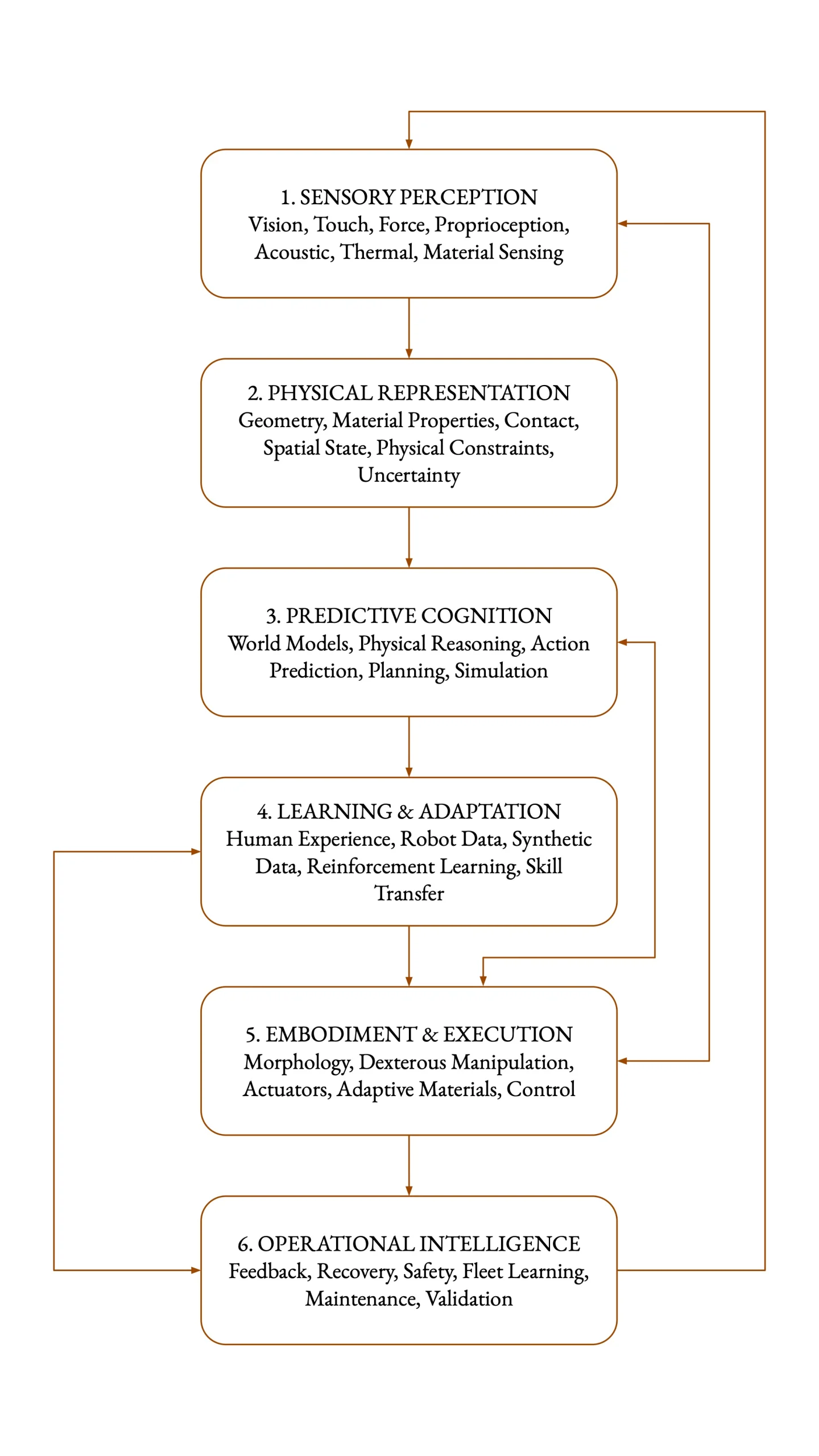
Figure 1. Conceptual architecture of Physical Intelligence. The architecture is a synthesis of the research directions examined, rather than an existing standard or a claim that a single implementation has already achieved full integration. The feedback connections represent continuous interaction between sensing, prediction, learning, physical execution and operational experience.
17. The Next Research Frontier: Beyond the Individual Robot.
The most groundbreaking development will be the emergence of physical intelligence that is distributed across networks of machines rather than confined to individual robotic systems.
Consider a population of robots operating across different factories, warehouses, laboratories and environments. One machine encounters an unfamiliar mechanical assembly and develops a successful manipulation strategy. It records the relevant sensory information, identifies the physical conditions, evaluates the resulting action and establishes a reusable representation of the skill. Other machines could potentially benefit from this experience, even if their hardware differs.
This possibility raises a new set of scientific and industrial questions. Can physical skills be represented independently of the robot morphology through which they were acquired? Can machines share knowledge about material properties, contact dynamics and mechanical interactions? Can the experiences of multiple robots contribute to a common predictive model of the physical world? How should unsuccessful interactions be represented, validated and transferred? Who owns the resulting data, learned skills and intellectual property?
The Open X-Embodiment collaboration provides an early example of the value of shared robotic experience. Its dataset combines more than one million trajectories from 22 robot embodiments, demonstrating that experience from different platforms can contribute to transferable capabilities. RoboColosseum addresses a complementary problem by making real-world evaluation more distributed and comparable. Together, these initiatives point towards the possibility of a shared infrastructure for learning and validating physical capabilities.
The analogy with cloud computing is useful, although not exact. Just as digital services can distribute computational resources and software capabilities across networks, future robotic systems may share validated skills, physical representations and environmental knowledge. The difference is that physical knowledge must remain grounded in the constraints of the receiving machine and its environment. A skill that works on one robot cannot simply be assumed to work on another without adaptation and verification.
This suggests that the next generation of Physical AI infrastructure may include shared skill libraries, interoperable action representations, distributed physical datasets, digital twins, robot identity and capability registries, and continuous validation systems. Such infrastructure could become as important to the industry as individual robot platforms or foundation models.
The result would not necessarily be one universal robot. It could be an ecosystem of specialised and general-purpose machines connected through common representations and learning infrastructure, each contributing to and benefiting from accumulated physical experience.
18. Strategic Research and Commercial Opportunities.
The technological developments examined in this work point towards several areas in which long-term research and commercial opportunities may emerge. Their importance derives from the fact that they address fundamental constraints across multiple forms of robotics rather than depending on the success of a particular humanoid manufacturer or AI model.
Cross-modal tactile intelligence could establish reusable physical sensing representations across different sensor technologies. Predictive world models could improve the ability of machines to anticipate the consequences of interaction. Simulation-to-reality learning could reduce the cost of acquiring physical experience. Cross-embodiment learning could make skills transferable across heterogeneous robotic platforms. Advanced compliant materials and intelligent actuators could expand the physical capabilities of machines, while robot operations infrastructure could make autonomous systems more dependable and economical to deploy.
Independent physical evaluation and certification could become another important area. As robots enter increasingly complex environments, the industry will require credible methods for measuring reliability, safety, recovery and sustained performance. The organisations capable of providing trusted evaluation infrastructure may become important participants in the robotics ecosystem.
Manufacturing infrastructure represents an additional opportunity. Precision actuators, dexterous hands, tactile sensors, calibration equipment, compliant mechanisms and automated testing systems are essential components of future robotic production. Their development may provide durable industrial value even if demand for humanoid robots grows more slowly than anticipated.
A particularly interesting research intersection lies between physical intelligence and advanced materials. Materials that can sense deformation, respond to external stimuli or adapt their mechanical properties could expand the design space of robotic systems. This creates opportunities extending beyond humanoids into medical devices, wearable robotics, industrial manipulation, adaptive structures and programmable matter.
The underlying principle is technological independence. A tactile representation architecture can improve conventional industrial manipulators. Predictive world models can support autonomous vehicles and mobile robots. Compliant materials can improve medical devices and collaborative machinery. Manufacturing automation can support the wider robotics supply chain. These capabilities retain their relevance even if particular products, companies or investment narratives fail.
Conclusion.
Artificial intelligence has demonstrated that increasingly sophisticated cognitive capabilities can emerge from large-scale learning, data and computational architectures. The next challenge is to establish how these capabilities can become reliably grounded in the physical world.
The emerging evidence suggests that this will not be achieved through foundation models alone. It requires the convergence of sensory perception, physical representation, predictive reasoning, experience-based learning, mechanical embodiment, adaptive materials and continuous feedback. The developments examined in this work demonstrate meaningful progress, but they also reveal the distance between controlled demonstrations and dependable physical capability.
Tactile representation models are beginning to address the fragmentation of physical sensing. Simulation-generated experiences are transferring into real-world locomotion and navigation. Human physical experience is being translated into robotic manipulation. Generalist models are beginning to adapt across embodiments, while open-source hardware and distributed evaluation infrastructure are lowering the barriers to experimentation. At the same time, research into compliant actuators and intelligent materials is expanding the possibilities of the physical body itself.
Yet the central scientific problem remains unresolved. How can a machine develop a sufficiently accurate, transferable and continuously updated understanding of the physical world to act reliably within it?
The answer may not lie in building a single universal humanoid or creating one increasingly large AI model. It may emerge through the integration of multiple forms of intelligence distributed across computation, perception, materials, mechanics and interaction. The most important advances may therefore come from technologies that receive less public attention than humanoid demonstrations but establish the foundations upon which dependable physical capabilities can be built.
The future of Physical Intelligence will not be determined solely by how closely machines imitate human movement, how many parameters their models contain or how impressive their demonstrations appear. It will depend on whether they can understand physical constraints, learn from interaction, adapt to uncertainty, recover from failure and consistently transform their environments.
The defining question is no longer simply how intelligent we can make a machine, but how deeply that intelligence can become grounded in the physical world.
Research Evidence and Maturity Assessment.
The following assessment distinguishes demonstrated research capability from operational and commercial maturity. The classifications are editorial judgements based on publicly available evidence as of 15 November 2026, they are not formal Technology Readiness Levels.
| Development | Evidence and demonstrated capability | Current maturity |
|---|---|---|
| Robbyant LingBot-Touch | Approximately 4,983 hours of tactile data, shared representations across three sensor principles, 26 real-world manipulation tasks, reported 14–26 percentage-point improvements in four policies | Research prototype with real-robot validation |
| Apple HALO | 300 hours of synthetic motion data across 1,000 environments, 91% reported success over 360 real-world trials in six unmapped environments | Research prototype with real-world validation |
| LiberAI Liber-0 | More than 2.2 million hours of human experience, 36% reported overall success across 600 zero-shot trials, substantial decline on multi-step tasks | Early research validation |
| NVIDIA GR00T 2 | Joint prediction of future video and robot actions, 40% reported zero-shot success on 50 tasks and 95% after five demonstrations | Company-reported controlled evaluation |
| Open X-Embodiment / RT-X | More than one million trajectories across 22 robot embodiments, evidence of positive transfer | Established research foundation |
| NYU MABEL | Open-source 56-DOF mobile bimanual platform, approximately US$8,056 base parts cost | Physical research platform |
| RoboColosseum | Distributed evaluation across 124 sites; 5,699 pairwise comparisons, exposed major gaps in open-world task completion | Emerging evaluation infrastructure |
| Soft dielectric and fluid actuators | Peer-reviewed 2026 review of material systems, actuation methods and engineering constraints | Active research and prototype development |
| Embodied AI AIR | Company-reported 95% average success in paid pilots, remote-to-autonomous deployment strategy | Early commercial pilot |
| ASUS Gallop | Internal factory workstation demonstration, 99.5% success is a target, not an achieved result, customer pilots planned for 2027 | Internal prototype and planned pilots |
| GXO–Apptronik Apollo | Expanded trials and an LOI for potential deployment of up to 1,000 robots, subject to agreed KPIs | Commercial development agreement, not scaled deployment |
| Figure operational infrastructure | Reported operator, teleoperation, night-shift and data-operations roles | Evidence of ongoing human-supported operations |
The maturity classifications should be interpreted conservatively. A successful laboratory experiment does not establish general industrial capability, a company-reported pilot result does not constitute independent validation, and a commercial agreement does not establish that the proposed deployment has occurred. No example in this assessment should be treated as proof that general-purpose physical autonomy has reached mature, independently verified commercial operation.
Selected Bibliography and References.
[1] Han et al. (2026). Learning Heterogeneous Tactile Representation for General Dexterous Manipulation – LingBot-Touch. arXiv:2611.12806.
[2] Tactile Beyond Pixels: Learning a Unified Representation for Robotic Touch. CoRL 2025 proceedings.
[3] Adaptive Intelligence in Tactile Sensing Robotic Hands (2026). Springer research article.
[4] Kirchner, Purschke and Knoll (2026). A Survey of World Models for Physical AI with Uncertainty Representation and Control. Discover Artificial Intelligence.
[5] NVIDIA Research (2026). GR00T 2: Scaling Robot Foundation Models for Generalization, Dexterity, and Adaptation. NVIDIA GEAR.
[6] LiberAI (2026). Liber-0: Emergent Zero-Shot Capabilities in Multi-Step Manipulation from 2.2 Million-Hour Human Experience. Research report.
[7] Open X-Embodiment Collaboration. Open X-Embodiment: Robotic Learning Datasets and RT-X Models. Research and dataset.
[8] Hu et al. (2026). Perceptive Humanoid Motion from Simulation – HALO. arXiv:2611.06908.
[9] Nguyen et al. (2026). RoboColosseum: Evaluating Physical Intelligence at Scale In-The-Wild. arXiv:2611.02497.
[10] RoboColosseum. Evaluation infrastructure and open datasets.
[11] Cheng et al. (2026). MABEL: An Open Anthropomorphic Mobile Bimanual Platform for Teleoperation and Learning. arXiv:2611.04083.
[12] Molla, Chen and Xu (2026). Advancing Soft Robotics: Recent Progress in Dielectric Elastomer and Fluid Actuators. npj Robotics. Research article.
[13] MABEL open-source hardware and software.
[14] ASUS (2026). Factory-Proven Physical AI: Why ASUS Is Building a Humanoid Robot – Gallop. ASUS Pressroom.
[15] GXO and Apptronik (2026). GXO and Apptronik Expand Partnership to Scale Humanoid Deployment. Official announcement.
[16] ISO 10218-1:2025. Robotics – Safety Requirements – Part 1: Industrial Robots. International Organization for Standardization.
[17] ISO 18646-5:2026. Robotics – Performance Criteria and Related Test Methods for Service Robots – Part 5: Locomotion for Legged Robots. International Organization for Standardization.